
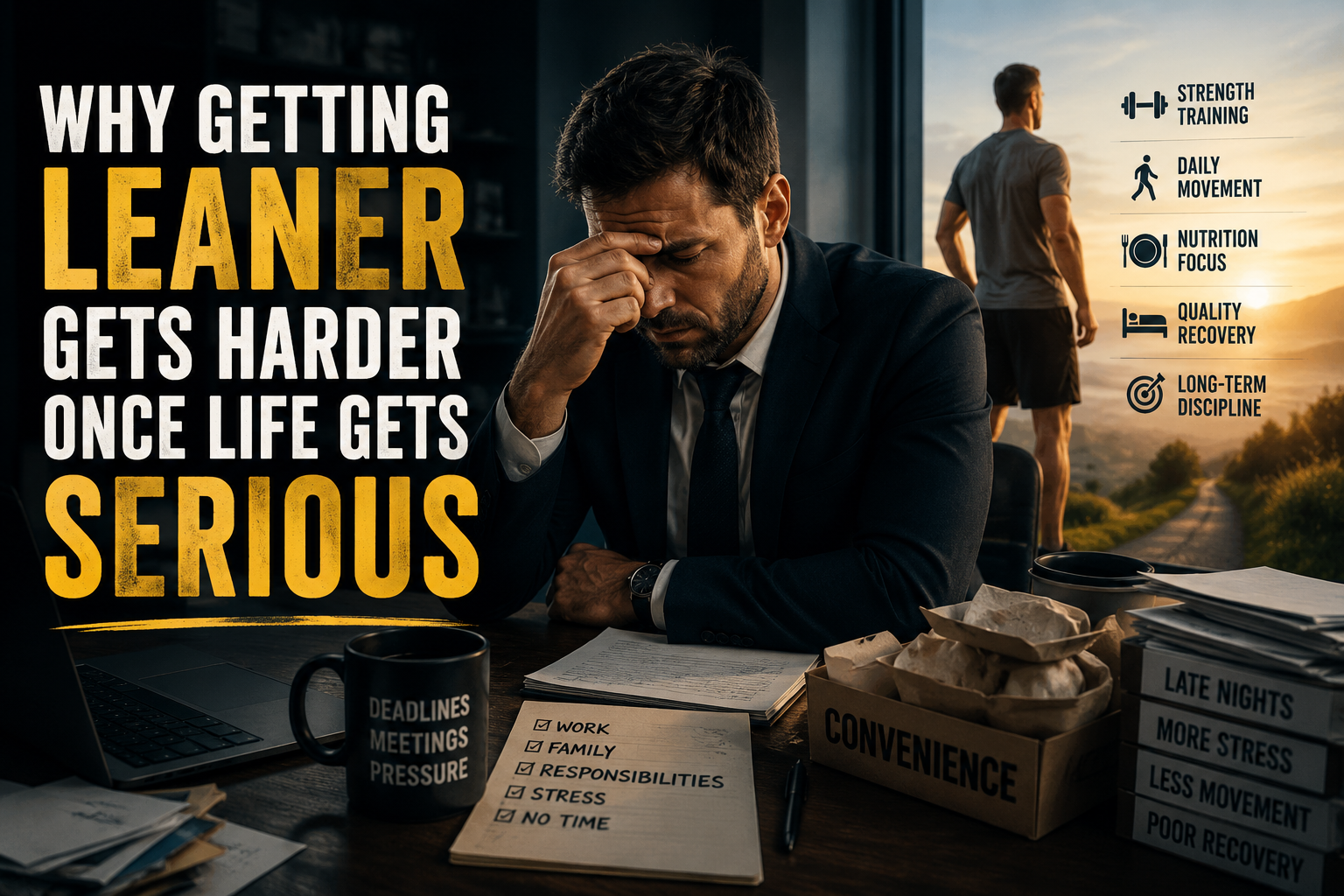
Why Getting Leaner Gets Harder Once Life Gets Serious
Most adults do not struggle with fat loss because they lack information. They struggle because life slowly changes the environment around them — and too many people try to solve environmental problems with willpower.
Most adults do not struggle with fat loss because they lack information.
In fact, many know exactly what they should be doing.
They know they should eat more protein.
They know they should exercise regularly.
They know they should walk more, sleep more, and drink less.
Yet despite having access to more nutritional information than any generation in history, maintaining a lean physique seems harder than ever.
This creates an uncomfortable question.
If people already know what to do, why do they continue struggling to do it?
The answer, I believe, is that most adults are fighting the wrong battle.
They think the challenge is knowledge.
They think the challenge is discipline.
They think the challenge is motivation.
In reality, the challenge is environment.
As life becomes more serious, the environment around us changes in subtle but powerful ways.
Career progression increases responsibility. Responsibility increases stress. Stress reduces recovery. Recovery affects appetite, decision-making, and consistency.
Daily movement declines. Convenience expands. Opportunities to overconsume become endless.
The result is a lifestyle that quietly pushes people towards weight gain while making fat loss increasingly difficult.
Most adults continue trying to solve this problem through willpower.
That is like trying to swim against a current that never stops flowing.
You may make progress temporarily.
Eventually the current wins.
The people who remain lean throughout adulthood do not necessarily possess more motivation than everyone else.
They simply understand something most people miss.
Long-term body composition is largely a consequence of systems and environments, not isolated acts of discipline.
Understanding this distinction changes everything.
Because once you stop viewing fat loss as a motivation problem, you can begin addressing the real causes.
The Lean Advantage You Had In Your Twenties
Many adults look back on their twenties and assume they stayed lean because they had a faster metabolism.
While there is some truth to age-related changes, I think this explanation massively overestimates biology and underestimates environment.
Think about how many people lived in their early twenties.
They walked more. Played sport more frequently. Worked active jobs. Had fewer family obligations. Spent less time sitting. Recovered more easily.
Many accumulated substantial amounts of physical activity without ever consciously trying to do so.
Fitness was not necessarily a deliberate strategy.
It was often a by-product of lifestyle.
As adulthood progresses, these advantages disappear.
The university campus becomes an office. The recreational football match becomes a board meeting. The active weekend becomes family logistics.
Movement declines not because people consciously choose inactivity, but because life gradually removes opportunities for movement.
The body responds accordingly.
This is one of the most important ideas in the entire article.
Most adults are not fighting the same fat-loss battle they were fighting at twenty-two.
They are operating in a completely different environment.
And different environments require different strategies.
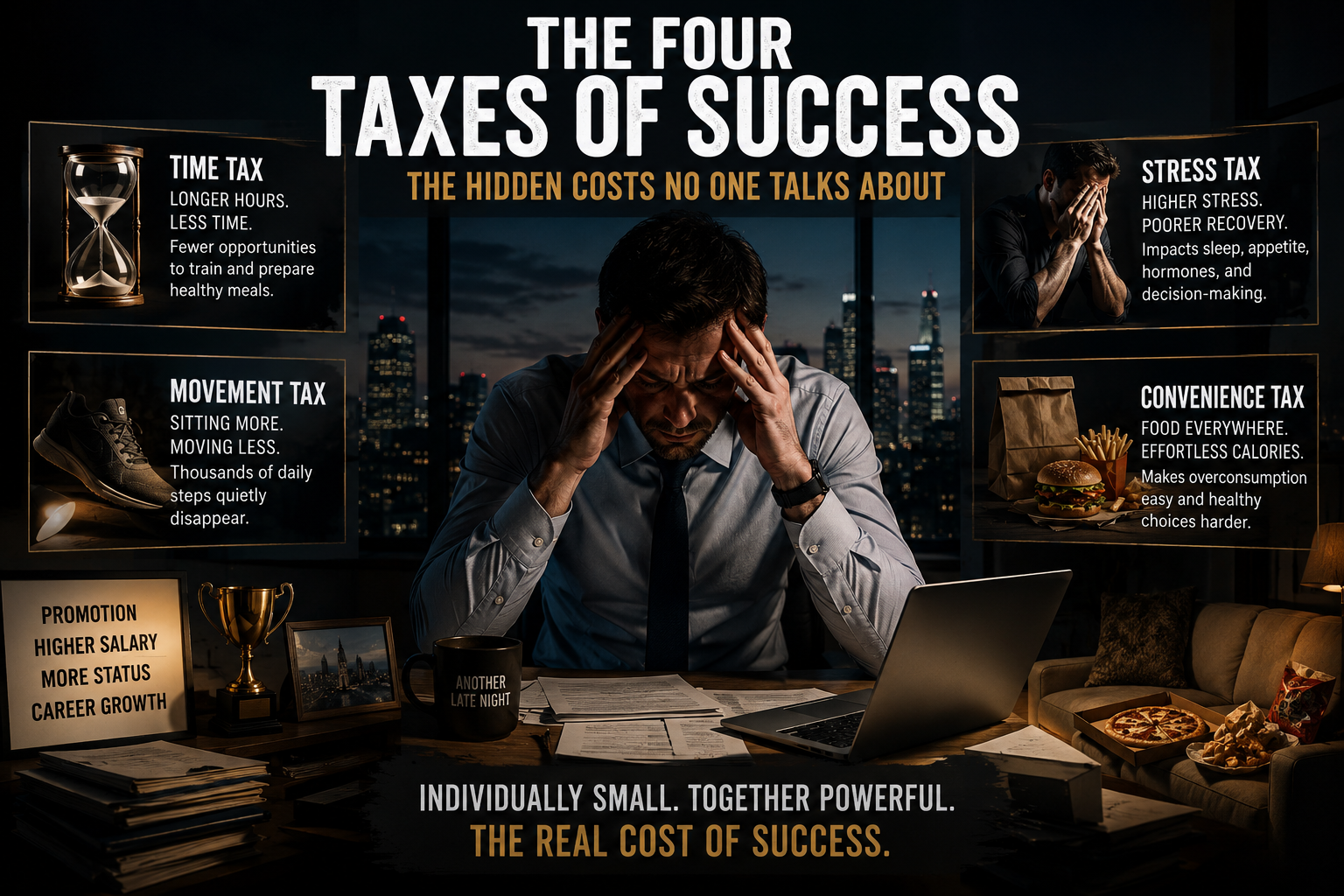
The Four Taxes of Success
In a previous article, I introduced what I call the Four Taxes of Success.
These are the hidden costs that often accompany professional progress.
The Time Tax.
The Movement Tax.
The Stress Tax.
The Convenience Tax.
Most people notice the benefits of success.
Few notice the taxes.
Yet these taxes help explain why maintaining body composition often becomes harder as careers advance.
The Time Tax reduces opportunities for training and meal preparation.
The Movement Tax quietly eliminates thousands of daily steps.
The Stress Tax influences sleep, appetite, and decision-making.
The Convenience Tax makes calorie consumption effortless.
None of these forces are particularly powerful in isolation.
Together, they create an environment where weight gain becomes increasingly likely.
Understanding these taxes explains why many highly capable professionals struggle with body composition despite succeeding in almost every other area of life.
The problem is not intelligence.
The problem is exposure.
They are living within an environment that constantly nudges behaviour in the wrong direction.
The Real Reason Fat Loss Feels Harder
Most adults assume fat loss becomes harder because they are getting older.
I think there is a better explanation.
Fat loss becomes harder because adulthood quietly changes the environment around you.
This distinction matters because it completely changes how the problem should be solved.
Imagine trying to stay dry while standing in the rain.
You could rely on determination. You could try harder. You could grit your teeth and tolerate it.
Or you could use an umbrella.
Most adults approach fat loss as though they are standing in the rain trying harder not to get wet.
They rely on motivation, discipline, willpower, and self-control.
Meanwhile the environment around them continues pushing in the opposite direction.
Food is available everywhere. Movement is optional. Work creates stress. Sleep becomes compromised. Convenience removes effort.
Every day requires hundreds of decisions.
Then people blame themselves when consistency becomes difficult.
The problem is not that they lack discipline.
The problem is that they are trying to solve an environmental problem with willpower.
This is one of the most important ideas in fitness.
Willpower is finite.
Environment is continuous.
Willpower eventually becomes exhausted.
Environment never does.
This explains why many highly intelligent and successful people struggle with body composition despite excelling in other areas of life.
It also explains why some people appear naturally lean.
Often they have not mastered discipline.
They have mastered environment design.
Their routines support their goals. Their defaults support their goals. Their lifestyle supports their goals.
Fat loss becomes easier because fewer decisions are required.
This is why I believe sustainable fat loss has less to do with becoming more disciplined and more to do with building better systems.
The objective is not to become someone who constantly resists temptation.
The objective is to create an environment where good decisions become the path of least resistance.
That is exactly what the Five Levers of Fat Loss help you do.
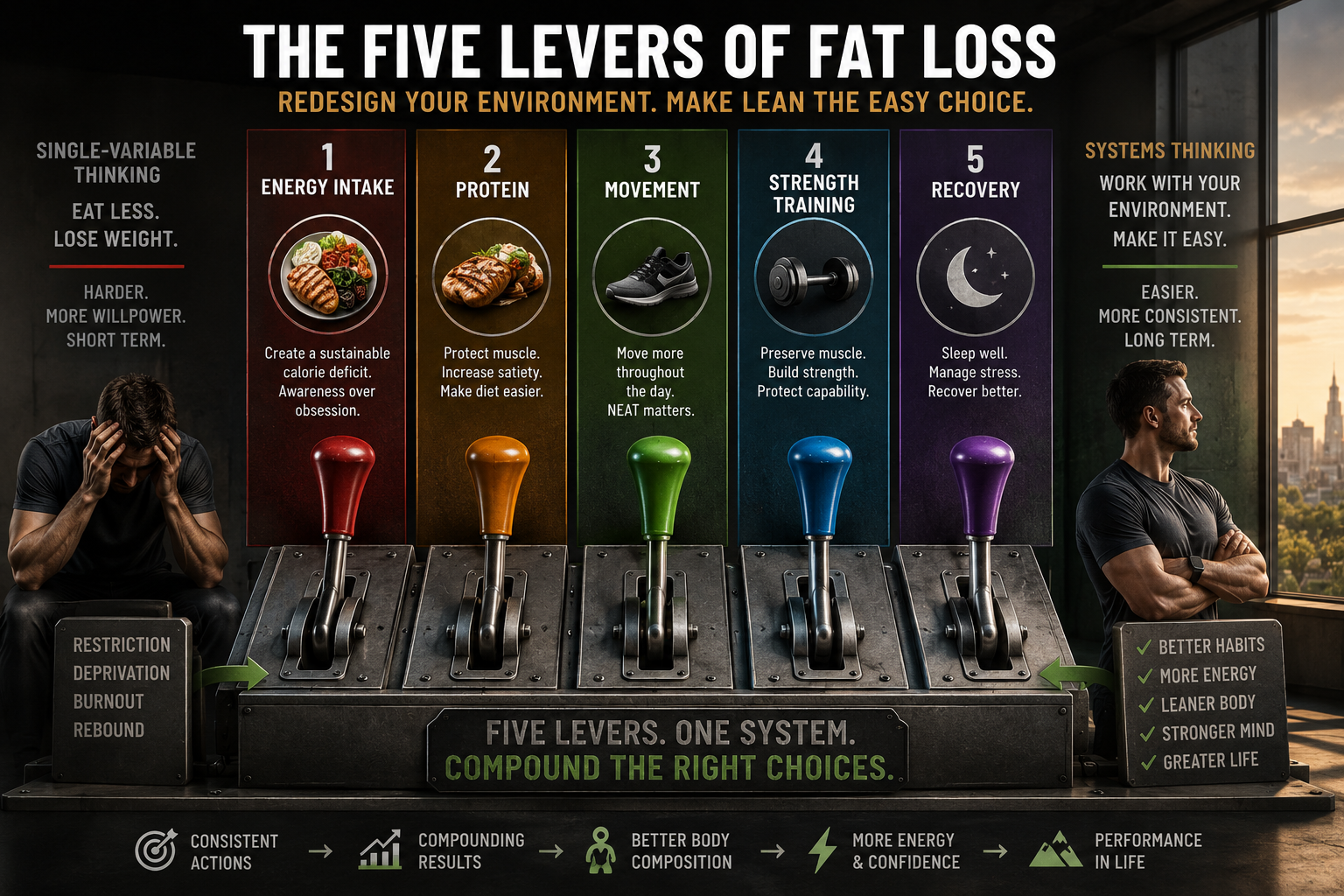
The Five Levers of Fat Loss
Most people treat fat loss as a single-variable problem.
Eat less.
Lose weight.
Reality is more complicated.
Body composition is influenced by five major levers.
Pulling the right levers consistently produces results.
Ignoring them creates frustration.
More importantly, each lever allows you to redesign your environment so that staying lean becomes easier rather than harder.
Lever 1: Energy Intake
Energy intake is the foundation of fat loss.
No matter which diet someone follows, fat loss ultimately requires consuming fewer calories than the body expends.
This does not mean calories are the only thing that matters.
It does mean they matter.
Modern life makes this surprisingly difficult.
Food is available everywhere. Portions are larger than ever. Restaurant meals often contain more calories than people realise.
Business lunches, social occasions, and convenience foods create endless opportunities for overconsumption.
Most weight gain does not occur because someone suddenly loses control.
It occurs because a small calorie surplus is repeated consistently over many years.
An extra few hundred calories per day rarely looks dramatic.
Yet over a decade it can completely change a physique.
The solution is not obsession.
It is awareness.
Understanding how energy balance works allows you to make informed decisions rather than emotional ones.
Lever 2: Protein
If energy intake determines whether weight is lost, protein helps determine what kind of weight is lost.
The goal is not simply becoming lighter.
The goal is becoming leaner.
Protein helps preserve muscle during fat loss.
It supports recovery.
It improves satiety.
It makes it easier to maintain a calorie deficit without feeling constantly hungry.
This is important because hunger is one of the biggest reasons diets fail.
Many adults attempt to reduce calories while keeping the structure of their diet exactly the same.
They become hungry. Energy levels drop. Cravings increase. Adherence collapses.
Protein helps solve this problem.
One of the simplest nutritional improvements most people can make is building every meal around a high-quality protein source.
Not because protein is magical.
Because it makes good decisions easier.
Lever 3: Movement
This may be the most overlooked lever in modern fat loss.
Most people think exercise and movement are the same thing.
They are not.
Exercise is something you deliberately do.
Movement is how you live.
A one-hour gym session cannot fully compensate for spending the remaining fifteen hours of the day sitting down.
Researchers refer to everyday movement as Non-Exercise Activity Thermogenesis, or NEAT.
This includes walking, standing, carrying things, household tasks, moving between locations, and general daily activity.
The fascinating thing about NEAT is how dramatically it varies between individuals.
Two people can train the same number of times per week, eat similarly, and weigh the same.
Yet one may burn hundreds more calories per day simply because they move more.
This is where modern professional life becomes problematic.
The more professionally successful many people become, the less they move.
Early in a career there may be travel between sites, physical tasks, commuting on foot, or active hobbies.
Later, success increasingly rewards sitting, thinking, planning, and decision-making.
The body, however, still responds to movement.
It does not care how many meetings you attended.
It does not care how many emails you answered.
It does not care how mentally exhausting your day felt.
It responds to physical activity.
This creates a challenge for many professionals.
They feel exhausted at the end of the day.
Yet they may have accumulated fewer than 4,000 steps.
This is why movement is so important.
It bridges the gap between mental work and physical health.
Walking remains one of the highest-return activities available.
It supports energy expenditure, cardiovascular health, recovery, stress management, and longevity.
Most importantly, it is sustainable.
Movement is not a calorie-burning strategy.
It is a lifestyle strategy.
And lifestyle is ultimately what determines long-term body composition.
Lever 4: Strength Training
Many people view strength training as a muscle-building activity.
I view it as a capability-preservation activity.
Muscle is one of the most valuable assets adults possess.
It supports strength, resilience, mobility, metabolic health, and long-term independence.
Without resistance training, muscle mass tends to decline gradually over time.
This creates a vicious cycle.
Less muscle.
Less strength.
Lower physical capability.
Greater difficulty maintaining body composition.
The objective is not becoming a bodybuilder.
The objective is remaining physically capable.
Three high-quality strength sessions per week can dramatically change long-term outcomes.
Remember, the goal is not simply weight loss.
The goal is preserving capability.
Lever 5: Recovery
Recovery may be the most underestimated lever of all.
Most people attempt to solve every problem with greater effort.
More discipline. More restriction. More training.
Yet poor recovery undermines every other lever.
When sleep declines, hunger often increases, cravings become stronger, decision-making worsens, training performance suffers, and stress tolerance decreases.
This creates what I call Recovery Debt.
Much like financial debt, recovery debt accumulates quietly.
A poor night of sleep here. A stressful week there. A few months of compromised recovery.
None seem significant individually.
Collectively they create a deficit that eventually demands repayment.
The irony is that many people respond by trying harder.
The real solution is often better recovery.
Recovery is not laziness.
Recovery is the foundation that allows everything else to work.
The Professional's Fat Loss System
After years working in fitness, I have become increasingly convinced that successful fat loss is remarkably boring.
Not easy.
But boring.
The professionals who stay lean for decades rarely rely on extraordinary discipline.
They rely on repeatable systems.
If I were designing a fat-loss system for a busy professional, it would look something like this:
- Strength train three times per week.
- Walk daily.
- Prioritise protein at every meal.
- Maintain awareness of calorie intake.
- Protect sleep aggressively.
That is it.
No detoxes.
No complicated meal plans.
No six-day training splits.
No endless optimisation.
The objective is not creating a perfect programme.
The objective is creating a system that still works when life becomes difficult.
Because life will become difficult.
The people who stay lean are not the people with perfect circumstances.
They are the people with systems robust enough to survive imperfect circumstances.
Final Thoughts
Getting leaner does become harder once life gets serious.
But not for the reasons most people believe.
The challenge is rarely a broken metabolism.
The challenge is that adulthood quietly changes the environment around you.
Less movement.
More stress.
Greater convenience.
Higher demands on your time.
Most people attempt to fight these forces with more willpower.
That approach rarely succeeds.
The people who remain lean throughout adulthood are not necessarily more disciplined than everyone else.
They simply build systems that work with reality rather than against it.
The Four Taxes of Success explain why fat gain becomes easier.
The Five Levers of Fat Loss explain how to fight back.
The mistake most adults make is trying to solve environmental problems with willpower.
The solution is redesigning the environment itself.
That is how sustainable fat loss is achieved.
Not through heroic effort for a few weeks.
But through systems that continue working for years.