
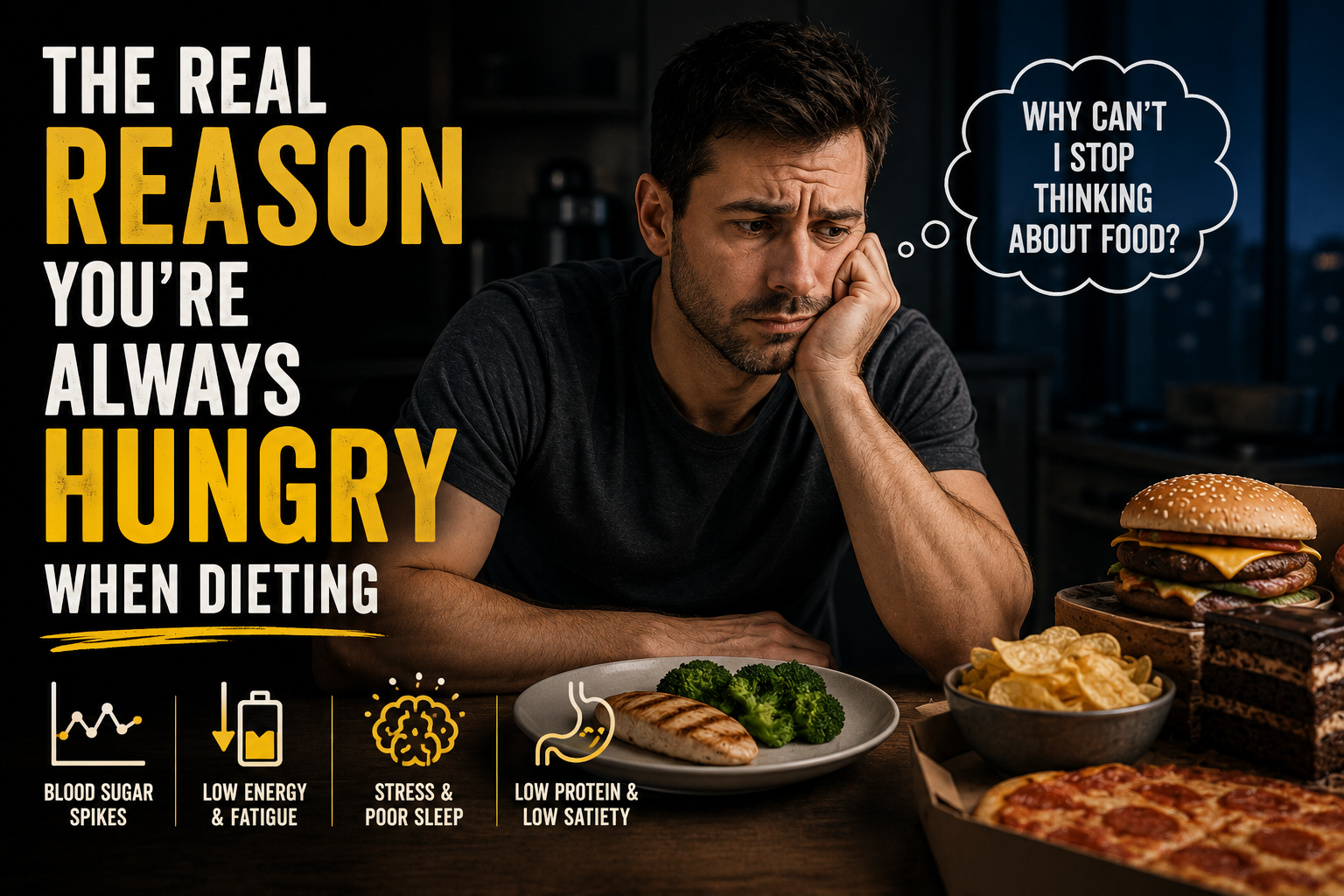
The Real Reason You're Always Hungry When Dieting
Hunger during dieting is not just a discipline problem. It is often your body's Energy Preservation System trying to protect stored energy, reduce expenditure, and restore what it perceives as balance.
Most People Think They're Fighting Calories. They're Actually Fighting Biology.
Most people believe dieting is fundamentally a test of discipline.
Eat less.
Move more.
Ignore your cravings.
Stay motivated.
If you succeed, you are disciplined.
If you fail, you simply didn't want it enough.
It is an attractive narrative because it appears logical and places responsibility firmly in our own hands.
Unfortunately, I think it is also one of the biggest reasons people repeatedly lose and regain the same weight throughout their lives.
The problem is rarely that people lack knowledge.
Most adults already understand that vegetables are generally healthier than doughnuts and that excessive takeaway meals are unlikely to improve body composition.
Nor is the problem usually intelligence.
Some of the most successful executives, entrepreneurs and professionals I know struggle with their weight despite possessing extraordinary levels of discipline in every other area of their lives.
The real problem is that they misunderstand the opponent.
They think they are fighting calories.
In reality, they are fighting millions of years of human evolution.
That changes the conversation completely.
The Biggest Misconception in Fat Loss
Imagine you own a successful business.
One month, revenue suddenly falls by twenty percent.
What happens next?
Does the finance director enthusiastically announce that spending should continue exactly as before?
Of course not.
Recruitment may slow.
Projects may be postponed.
Travel budgets may be reviewed.
Efficiency suddenly becomes a priority.
The organisation begins protecting itself.
Not because it is broken.
Because it is behaving intelligently.
Your body does something remarkably similar.
Body fat is not simply stored weight.
It is stored energy.
From an evolutionary perspective, stored energy represented survival.
For the overwhelming majority of human history, food was uncertain.
Periods of abundance were often followed by periods of scarcity.
Individuals whose bodies aggressively protected energy stores were more likely to survive long enough to reproduce.
The descendants of those people are all around us today.
Including you.
When you decide to diet, you are making a conscious decision to reduce energy intake.
Your body does not interpret it that way.
It receives a much simpler message:
Energy availability has fallen. We should probably do something about that.
From that moment onwards, your physiology begins working to restore what it perceives to be normal.
This is not sabotage.
It is survival.
I call this The Energy Preservation System.

The Energy Preservation System
Most people imagine their body operates like a calculator.
Calories in.
Calories out.
Simple mathematics.
Reality is considerably more sophisticated.
Your body is closer to a multinational organisation than a calculator.
Different departments have different responsibilities, but they all share one objective:
Preserve energy whenever resources appear threatened.
Some departments attempt to increase energy intake.
Others reduce energy expenditure.
Others alter behaviour.
Others change motivation.
Collectively they create a remarkably effective defence against prolonged energy shortage.
Ironically, this defence system is one of the reasons dieting becomes progressively harder the longer it continues.
Many people assume this means they are losing motivation.
I think something much more interesting is happening.
Your body is adapting.
Department One: The Hunger Alarm
One of the first systems to become more active involves a hormone called ghrelin.
You do not need to remember its scientific name.
It is easier to think of ghrelin as the body's hunger alarm.
Its role is straightforward.
It tells your brain that it may be time to eat.
When dieting, ghrelin levels frequently increase.
This should not be surprising.
If your body believes energy availability has declined, encouraging food intake is an entirely sensible strategy.
The practical consequence, however, is significant.
You become hungrier.
Meals disappear more quickly.
You begin thinking about food more often.
Many people interpret this as evidence that their diet is failing.
Others conclude they lack discipline.
I think both conclusions are mistaken.
The hunger alarm is functioning exactly as it was designed to.
It is attempting to solve what your body perceives to be an energy shortage.
Imagine the smoke detector in your house began sounding because there was smoke in the kitchen.
You would not criticise the alarm for doing its job.
You would recognise that it was responding to information.
Ghrelin behaves similarly.
The signal is not the problem.
It is simply information.
Department Two: The Fuel Gauge
If ghrelin is the hunger alarm, leptin is the body's fuel gauge.
Leptin is produced primarily by fat tissue and communicates information about stored energy reserves to the brain.
Imagine driving across the country.
As your fuel gauge approaches empty, your priorities change.
You begin noticing petrol stations you previously ignored.
You may become reluctant to take unnecessary detours.
Your behaviour adapts because the information available to you has changed.
Leptin performs a similar function.
As body fat decreases, leptin levels generally decline.
Your brain receives a message that energy reserves are lower than before.
It responds logically.
Appetite increases.
Feelings of fullness become weaker.
The drive to restore those reserves becomes stronger.
One of the cruel ironies of fat loss is that the better you do, the harder your body may work to encourage you to reverse it.
Many people experience this and conclude that motivation fades over time.
In reality, biology is changing the environment in which motivation operates.
This distinction matters enormously.
Because it shifts the conversation from self-blame to system design.
Department Three: Your Brain Starts Marketing Food
One of the strangest experiences during dieting is that food suddenly appears to become more interesting.
The pastries in the office.
The smell from the bakery.
The dessert menu you would normally ignore.
The television advert that somehow makes a burger look irresistible.
Most people assume these foods have become more tempting.
They have not.
Your brain has simply changed the priority assigned to them.
Think of this department as your body's marketing team.
Its objective is straightforward:
Find energy.
From an evolutionary perspective, this is brilliant.
If food becomes more rewarding during periods of scarcity, you are more likely to seek it out and survive.
Unfortunately, this creates a problem for the modern dieter.
The environment has not changed.
Your response to the environment has.
This is why people often report thinking about food all day while dieting.
It is not necessarily a failure of discipline.
It is evidence that the marketing department has significantly increased its advertising budget.
And unlike social media, you cannot simply turn it off.
Department Four: The Cost-Cutting Programme
Perhaps the most fascinating adaptation of all is one that most people never notice.
Scientists refer to it as adaptive thermogenesis.
The scientific terminology sounds intimidating.
The concept itself is remarkably intuitive.
Think of it as the body's cost-cutting programme.
Return to our business analogy.
Revenue has fallen.
The finance director now looks for opportunities to reduce expenditure.
Large expenses are reviewed.
Small expenses are reviewed.
Even tiny inefficiencies begin attracting attention.
Your body behaves in remarkably similar ways.
When energy intake declines, it quietly attempts to become cheaper to run.
You may fidget less.
Stand less.
Walk slightly slower.
Take fewer unnecessary steps.
Sit for longer periods.
Choose convenience more often.
The remarkable part is that these changes frequently occur below conscious awareness.
You do not wake up one morning and decide to burn fewer calories.
Your body simply becomes more efficient.
Individually, these adjustments appear trivial.
Collectively, they can substantially reduce daily energy expenditure.
Many people interpret this as a fat-loss plateau.
They assume they need more discipline.
Often their body has simply become more economical.
The finance director has done an excellent job.
Unfortunately, it makes your job considerably harder.
Department Five: The Emergency Manager
There is one final department within the Energy Preservation System that deserves attention because it explains why dieting often feels dramatically harder during stressful periods.
Its name is cortisol.
Most people know cortisol as "the stress hormone."
While technically accurate, I do not think that description is particularly helpful.
I prefer to think of cortisol as the body's emergency manager.
Imagine your company suddenly experiences a major crisis.
Perhaps a cyberattack.
Perhaps a significant client leaves.
Perhaps an unexpected legal issue appears.
The board is no longer discussing its five-year strategy.
Everything becomes focused on solving today's problem.
Long-term optimisation gives way to short-term survival.
Your body behaves similarly.
When psychological stress increases, whether through work pressure, financial responsibility, lack of sleep or family demands, your physiology shifts its priorities.
The objective becomes immediate survival rather than long-term body composition.
This is why many professionals experience a familiar pattern.
They complete a stressful day.
They arrive home exhausted.
They know exactly what they should eat.
Yet suddenly takeaway food, chocolate or alcohol becomes extraordinarily appealing.
Most people blame themselves.
They say they lacked discipline.
I think a better explanation exists.
Their emergency manager has temporarily taken control.
The body is seeking immediate comfort, immediate energy and immediate reward.
It is attempting to solve a physiological problem through behavioural means.
Understanding this changes the conversation.
The goal is no longer becoming mentally tougher.
The goal is creating an environment where good decisions remain easy, even when the emergency manager is in charge.
The Energy Preservation System Works Brilliantly
At this point you may wonder whether the human body is fundamentally working against you.
It is not.
In fact, it is doing an extraordinary job.
If we were living twenty thousand years ago, every adaptation we have discussed would improve your chances of survival.
Increasing hunger when food is scarce is sensible.
Reducing unnecessary movement is sensible.
Protecting stored energy is sensible.
Making food appear more rewarding is sensible.
The problem is that evolution has not caught up with modern abundance.
Your brain is still optimised for scarcity.
Your environment is optimised for excess.
The conflict between those two realities is what makes fat loss difficult.
This is why I dislike the common advice to simply "try harder."
You are not competing against laziness.
You are competing against one of the most sophisticated survival systems ever created.
Why Aggressive Diets Usually Fail
The internet loves dramatic transformations.
Lose twenty pounds in six weeks.
Get shredded in thirty days.
Destroy body fat fast.
The mathematics appears attractive.
The physiology often disagrees.
The larger the calorie deficit, the louder the Energy Preservation System becomes.
The hunger alarm rings more frequently.
The fuel gauge becomes increasingly concerned.
The marketing department fills your brain with thoughts of food.
The finance director cuts expenditure.
The emergency manager seeks immediate relief.
Eventually something gives.
Many people interpret this moment as failure.
In reality, it is often predictable.
They designed a strategy that required constant victory over biology.
Very few people win that battle forever.
Ironically, slower fat loss frequently produces better long-term outcomes because it provokes less resistance.
The objective should not be losing weight as quickly as possible.
It should be losing weight while creating the smallest possible defensive response from your body.
Those are very different goals.
The Real Solution Is Not More Discipline
Once you understand the Energy Preservation System, many conventional pieces of nutrition advice suddenly make far more sense.
Protein is not valuable simply because it helps build muscle.
It helps because it generally improves satiety while preserving lean tissue during dieting.
High-volume foods are not valuable simply because they contain fewer calories.
They help satisfy a body that is actively searching for food.
Fibre is not interesting because nutrition textbooks say so.
It slows digestion and helps maintain fullness.
Sleep is not merely recovery.
It influences appetite regulation and decision-making.
Stress management is not simply about mental wellbeing.
It reduces unnecessary activation of the emergency manager.
Even walking becomes more important.
Not because walking is magical.
But because it offsets some of the body's quiet attempts to reduce energy expenditure.
Notice something interesting.
None of these strategies attempt to defeat biology.
They simply reduce the amount of biology working against you.
That is a much smarter objective.

Introducing MEDs: Minimum Effective Doses
There is one final idea that I believe brings everything together.
Throughout this article we have seen that your body possesses an incredibly sophisticated Energy Preservation System.
It is attempting to protect you.
The mistake many people make is responding by attempting perfection.
Perfect nutrition.
Perfect training.
Perfect discipline.
Perfect consistency.
Eventually real life arrives.
A business trip.
A birthday meal.
A stressful project.
Poor sleep.
Suddenly perfection disappears.
The diet collapses.
I think there is a better philosophy.
Instead of asking:
How can I have the perfect day?
Ask:
What is the Minimum Effective Dose required to keep moving forwards?
A Minimum Effective Dose, or MED, is the smallest input that still produces a meaningful return.
This concept already exists throughout medicine and exercise science.
It should also exist in everyday nutrition.
Perhaps today you cannot train for ninety minutes.
Can you still achieve your movement MED?
Perhaps your meals are not ideal.
Can you still achieve your protein MED?
Perhaps work is chaotic.
Can you still achieve your sleep MED by getting to bed thirty minutes earlier?
The remarkable thing about MEDs is that they transform success from perfection into progress.
You no longer need an extraordinary day.
You simply need enough meaningful actions to continue moving in the right direction.
Why MEDs Work With The Fitness Forgiveness System
In an earlier article I introduced the Fitness Forgiveness System.
Its principle is simple:
A good fitness system assumes life will go wrong.
MEDs are how that philosophy operates in practice.
If you achieve your MEDs today, the system forgives the imperfect lunch.
It forgives the missed workout.
It forgives the stressful meeting.
It forgives the unexpected takeaway.
Because your progress is no longer dependent upon flawless execution.
It is dependent upon consistently achieving enough meaningful inputs over time.
This is exactly how successful organisations operate.
They do not require perfect days.
They require resilient systems.
Your fitness should be no different.
Final Thoughts
Most people believe hunger means one of two things.
Either the diet is working.
Or they are failing.
The truth is considerably more interesting.
Hunger is part of an ancient survival system designed to preserve energy whenever resources appear threatened.
Your body is not trying to sabotage your goals.
It is trying to protect your existence.
Understanding that changes everything.
Successful fat loss is no longer about defeating yourself through extraordinary willpower.
It becomes an exercise in intelligent system design.
The people who stay lean for decades are rarely those who fight their biology the hardest.
They are the people who understand it well enough to work alongside it.
And they understand one final principle.
Perfect days are rare.
Real life is messy.
Long-term success is not built by accumulating perfect days.
It is built by accumulating enough good days.
So stop asking yourself:
Was today perfect?
Instead ask:
Have I achieved my MEDs today?
Because sustainable fat loss is rarely the product of extraordinary effort.
It is the product of consistently achieving the minimum effective doses that allow progress to continue while life remains imperfect.