
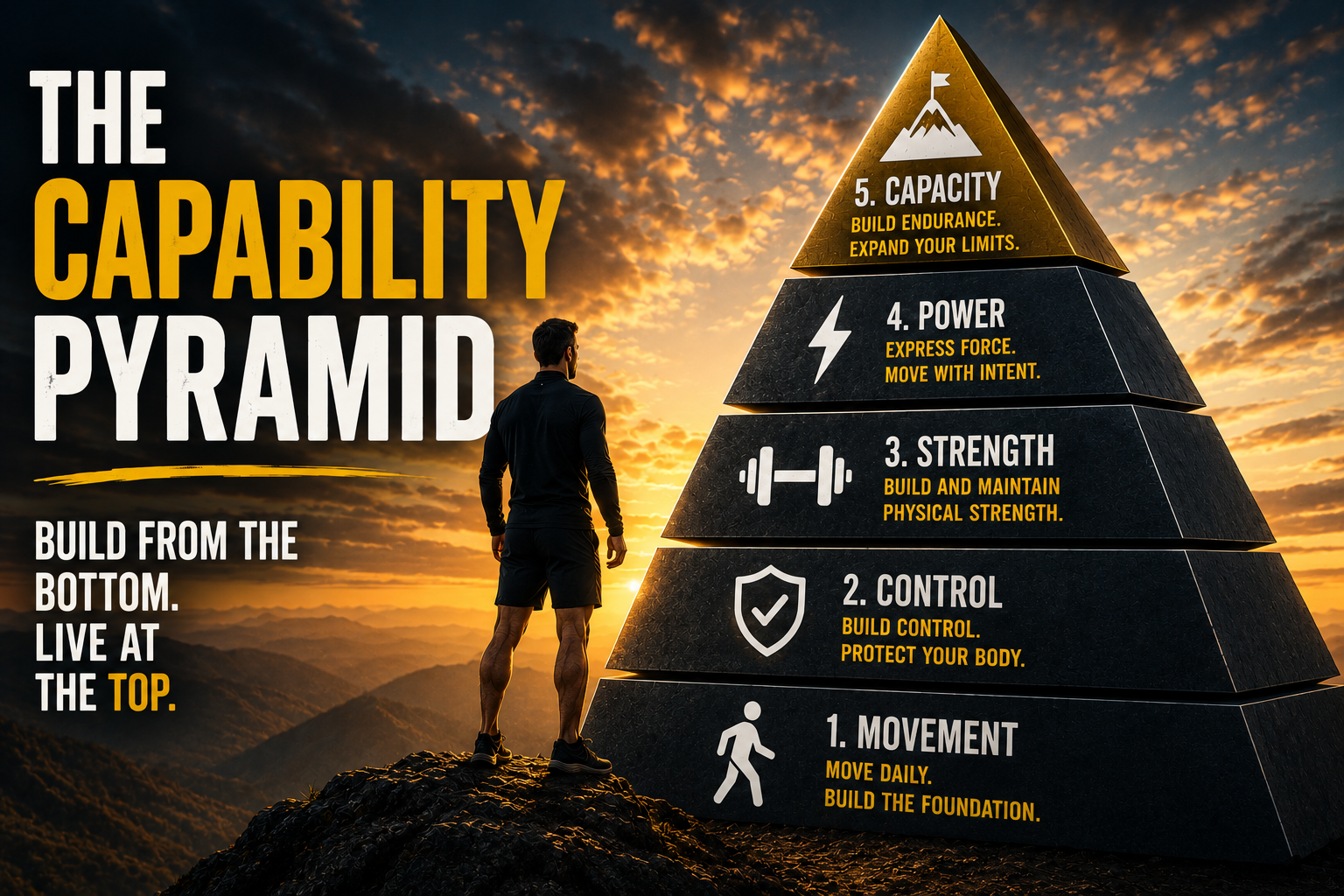
The Capability Pyramid
Most people train isolated qualities like strength, cardio or mobility. The smarter approach is to build capability from the ground up, because every physical quality depends on the layers beneath it.
Why Most Adults Train the Wrong Thing
Imagine you're responsible for building a fifty-storey skyscraper.
The architects are world class. The glass exterior is spectacular. The penthouse apartments are worth millions. The rooftop garden wins design awards.
Then, halfway through construction, an engineer asks a simple question:
How strong are the foundations?
Suddenly nothing else matters.
The quality of the fiftieth floor is entirely dependent on what sits underneath it. You cannot compensate for weak foundations with better architecture. You cannot decorate structural weakness away. Every additional floor simply places more stress on an already unstable base.
Human performance works exactly the same way.
Unfortunately, most people build their bodies upside down.
They chase visible muscles before movement.
High-intensity workouts before consistency.
Explosive exercises before basic strength.
Sport-specific performance before general capability.
The result is predictable.
Progress slows. Injuries appear. Confidence declines. Eventually motivation disappears.
Most people conclude that fitness "doesn't work for them."
I think something else happened.
They were trying to build the penthouse while ignoring the foundations.
The Mistake We Make About Fitness
Ask someone what fitness means and you'll receive dozens of different answers.
Strength.
Cardio.
Flexibility.
Mobility.
Balance.
Coordination.
Power.
Endurance.
Most people think these are separate qualities that should be trained independently.
I don't.
I think they are layers of the same structure.
Like a pyramid.
Each layer supports the next.
Remove one of the lower layers and everything above becomes unstable.
This explains why two people can follow identical programmes yet achieve completely different outcomes.
One has solid foundations.
The other is trying to build on sand.
The question therefore isn't:
What exercise should I do?
It's:
Which layer of my Capability Pyramid needs investment?
Level One: Movement
Every building starts with foundations.
Every human starts with movement.
Long before we discuss barbells, running programmes or advanced training systems, we should ask a much simpler question:
Can your body comfortably perform the movements that everyday life requires?
Can you squat to pick something up from the floor? Can you reach overhead without compensating? Can you rotate comfortably? Can you kneel? Can you stand back up? Can you balance on one leg? Can you sit on the floor and rise again?
None of these movements are particularly impressive.
Nobody posts them on social media.
Yet they underpin almost every physical task you'll ever perform.
Movement is not fitness.
Movement is the language through which fitness is expressed.
Imagine trying to write a novel using only twenty words.
Technically possible.
Practically impossible.
Many adults have unintentionally reduced their movement vocabulary in exactly this way.
They walk. They sit. They drive. They type. They sleep.
Then they wonder why their bodies struggle when life suddenly asks them to climb a ladder, scramble over rocks or carry awkward luggage.
The issue is not necessarily strength.
Often it's simply that their movement vocabulary has become too small.
Level Two: Control
Movement alone is not enough.
The body must also control movement.
Watch a toddler learning to walk.
The movement exists.
The control does not.
Watch someone learning to squat for the first time.
Their knees drift. Their weight shifts. Their torso collapses. Their nervous system is attempting to coordinate dozens of muscles simultaneously while solving a completely unfamiliar problem.
This explains one of the strangest observations in strength training.
Beginners often become dramatically stronger within a few weeks despite gaining almost no muscle.
Their muscles haven't changed much.
Their nervous system has.
The software improved before the hardware.
Think about learning to drive.
Initially every action requires conscious thought.
Mirror. Signal. Clutch. Gear. Steering.
Months later you complete an entire journey while thinking about tomorrow's meeting.
The movement has become automated.
Your body works the same way.
Every repetition teaches your nervous system a slightly better solution.
This is why technique matters.
You're not merely performing today's lift.
You're programming tomorrow's movement.
Good repetitions create good habits.
Poor repetitions create poor habits.
Your nervous system doesn't distinguish between them.
It simply learns whatever you repeatedly teach.
Level Three: Strength
Only once movement and control exist does strength become truly valuable.
Strength is often misunderstood.
People imagine it means lifting extraordinary weights.
I think a better definition is this:
Strength is reserve capacity.
Life rarely asks for maximum effort.
Instead, it repeatedly asks for moderate effort.
Carry shopping. Lift a child. Move furniture. Push a stalled car. Help a friend. Recover after illness. Walk upstairs carrying luggage.
Everyday life is simply a series of physical problems.
The stronger you become, the smaller those problems feel.
Imagine two people carrying identical suitcases through an airport.
For one person, the suitcase represents ninety percent of their strength.
For the other, it represents twenty percent.
The suitcase weighs exactly the same.
Yet the experience is entirely different.
Strength creates margin.
Financial savings create resilience against unexpected expenses.
Physical strength creates resilience against unexpected demands.
Weak people often operate close to their physical limit.
Strong people possess capacity they may never fully need.
That reserve is freedom.
Level Four: Power
Power is strength expressed quickly.
It is the ability to generate force at speed.
You use power every time you jump.
Every time you catch yourself after slipping.
Every time you change direction.
Every time you react to something unexpected.
Ironically, many adults believe power disappears because of age.
I think it often disappears because everything beneath it disappeared first.
Power cannot exist without strength.
Strength cannot exist without control.
Control cannot exist without movement.
Trying to improve explosive performance while ignoring the lower layers is like fitting a Formula One engine into a car with damaged suspension.
The engine isn't the problem.
The platform is.
This is why so many people plateau.
They're trying to improve the top of the pyramid when the limitation sits much lower.
Level Five: Capacity
People often think endurance sits at the foundation of fitness.
I don't.
It sits much higher.
Capacity is your ability to repeatedly perform work.
But the cost of that work depends upon everything beneath it.
Imagine asking two people to carry groceries upstairs.
One is operating at ninety percent of their maximum strength.
The other is operating at twenty percent.
Who becomes exhausted first?
Probably the weaker person.
The stronger foundation makes the same task cheaper.
This is one reason strength training often improves endurance even without significant cardiovascular changes.
Everyday life simply becomes less physically expensive.
The body spends less of its available resources solving ordinary problems.
The result is greater capacity for everything else.
Level Six: Confidence
This is the layer most people misunderstand.
They think confidence sits outside physical capability.
I think it sits at the very top of it.
Confidence is rarely motivational.
Confidence is accumulated evidence.
Imagine two people standing beneath a climbing wall.
One climbed trees every weekend as a child and still hikes regularly.
The other hasn't climbed anything for thirty years.
Who feels more confident?
Usually the first.
Not because they possess superior mindset.
Because their nervous system has solved this problem before.
The brain constantly estimates risk by asking:
Have we successfully done something like this before?
If the answer is yes, confidence appears.
If the answer is no, hesitation appears.
This explains why capability and confidence reinforce one another.
The more capable you become, the more willing you are to attempt new challenges.
The more challenges you attempt, the more capable you become.
The cycle compounds.
Unfortunately, so does the opposite.
Less movement creates less confidence.
Less confidence creates less movement.
The pyramid can grow upwards.
Or collapse downwards.
The Pyramid Explains Ageing Better Than Age Does
Perhaps the most interesting implication of this model is that many changes we attribute to ageing may actually reflect the gradual erosion of lower layers.
People say:
I've lost my balance.
Perhaps they lost movement.
I've become weaker.
Perhaps they lost control.
I've become slower.
Perhaps they lost strength.
I've lost confidence.
Perhaps they lost capability.
The body is remarkably adaptive.
It simply becomes better at the life you repeatedly ask it to perform.
Spend decades sitting and it becomes excellent at sitting.
Spend decades moving and it remains remarkably capable.
The body is not making mistakes.
It is responding to evidence.
The Capability Portfolio
Most adults have a financial portfolio.
Cash.
Investments.
Property.
Pensions.
Diversification protects them against uncertainty.
I think your body deserves the same thinking.
Every week you should ask:
Have I moved well?
Have I controlled movement well?
Have I challenged my strength?
Have I expressed power?
Have I built capacity?
Have I invested in confidence?
You're not simply exercising.
You're making deposits into different parts of your Capability Portfolio.
Some weeks one area receives more attention than another.
That's perfectly normal.
The objective is not perfection.
The objective is ensuring no layer quietly disappears through neglect.
Final Thoughts
Most people think they're training muscles.
Some think they're training fitness.
I think they're training for the questions life hasn't asked yet.
Can you carry this?
Can you climb that?
Can you catch yourself?
Can you keep going?
Can you help someone else?
The answer to those questions will never be determined by one workout or one exercise programme.
It will be determined by the strength of the pyramid you've been quietly building for decades.
So stop asking:
What's the best workout?
Start asking:
Which layer of my Capability Pyramid am I investing in today?
Because the strongest people are rarely those who can do one thing exceptionally well.
They're the ones who remain capable across the widest range of human problems.
And that's the kind of fitness that compounds for a lifetime.