
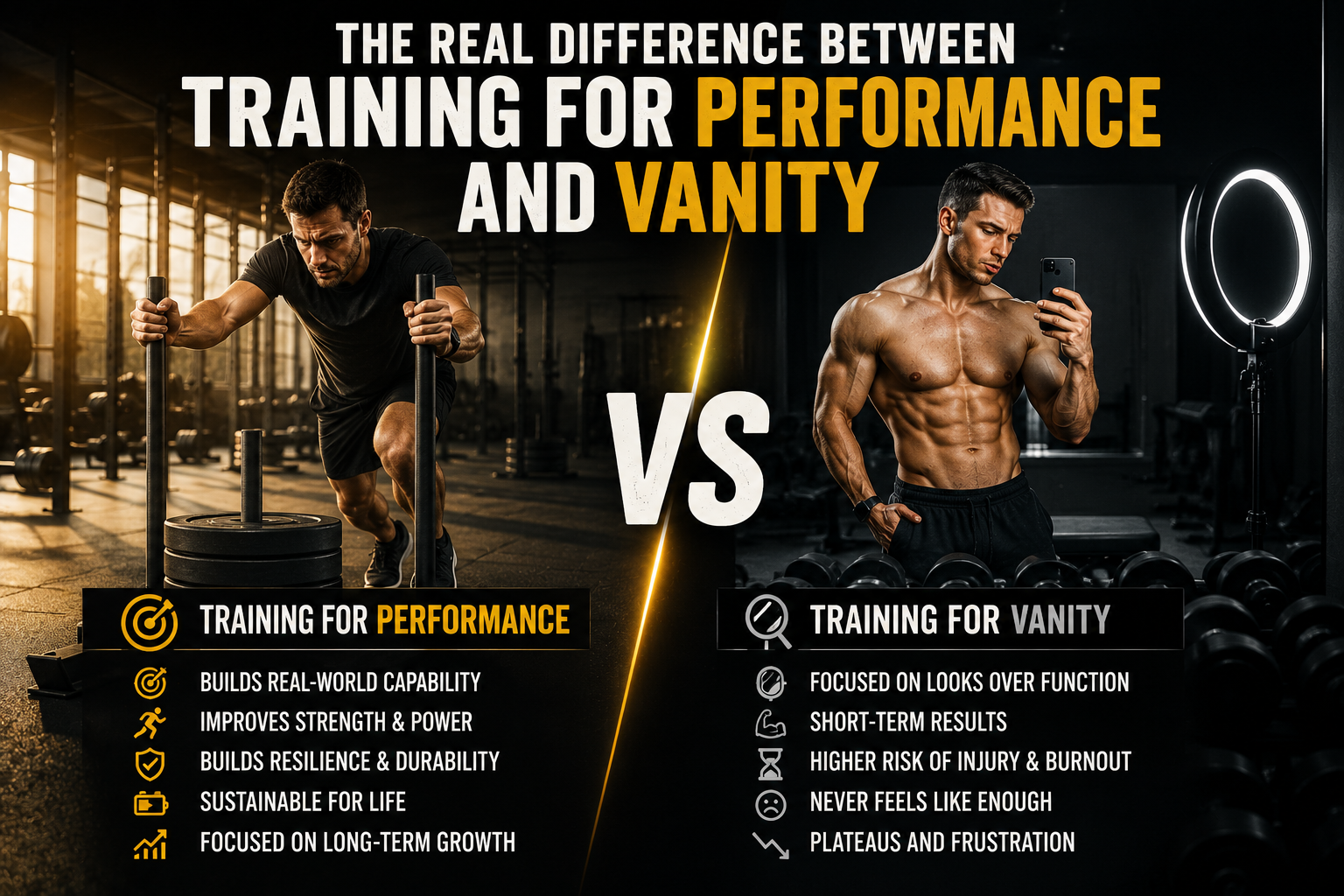
Appearance Is a Dividend, Not the Investment
Vanity training asks how your body looks. Performance training asks what your body can do. The irony is that the physique many people want is often a by-product of building real capability.
The Mirror Is Lying to You About What Fitness Is
Imagine you're hiring a CEO to run a multi-billion-pound company.
Candidate A arrives wearing an immaculate suit. They speak confidently, use impressive business jargon and graduated from a prestigious university. Their CV is beautifully presented and filled with recognisable company names.
Candidate B is less polished. Their CV is shorter. Their suit is ordinary. They don't sound rehearsed.
Now imagine you have one hour to decide who will be responsible for billions of pounds of shareholder value.
What question do you ask?
You probably don't ask:
Who looks more like a CEO?
You ask something very different.
Tell me about the most difficult business problem you've ever solved.
Almost every great organisation hires this way.
They aren't buying appearances.
They're buying capability.
They're trying to answer one question:
Can this person solve problems when reality becomes difficult?
That's a remarkably sensible way to evaluate another human being.
Yet very few people apply the same logic to their own body.
Instead they stand in front of a mirror and ask:
Do my arms look bigger?
Are my abs visible?
Have my shoulders grown?
Is my waist smaller?
The mirror has quietly become the judge of success.
I think that's one of the biggest mistakes in modern fitness.
Because life has never once asked me what my body fat percentage was.
Life asks completely different questions.
Can you carry this?
Can you climb that?
Can you lift your child?
Can you keep going when you're tired?
Can you help someone else?
Your body is interviewed every single day.
And unlike a job interview, there is no opportunity to exaggerate your experience.
The Elon Musk Interview Test
One of the reasons Elon Musk has spoken about asking candidates to describe the hardest problems they have personally solved is because genuine problem solvers remember the details.
Someone who actually solved the problem remembers the setbacks, the failed attempts and the reasoning behind their decisions.
Someone who simply attached themselves to a successful project often speaks in vague generalities.
In other words, he's not primarily evaluating credentials.
He's looking for evidence.
Capability leaves fingerprints.
It can be examined.
It can be tested.
It can be demonstrated.
The same principle applies to your body.
Your body doesn't care whether you own expensive gym clothes.
It doesn't care how many fitness influencers you follow.
It doesn't care how many nutrition books you've read.
Your nervous system asks a much simpler question:
What evidence do I have that these capabilities are actually required?
If you repeatedly lift heavy objects, your body concludes strength matters.
If you repeatedly sprint, it concludes speed matters.
If you repeatedly climb, carry, jump and move, it concludes those abilities deserve investment.
Your body is making hiring decisions every single day.
It allocates resources only to departments that continue proving their value.
Everything else is quietly downsized.
Your Body Doesn't Know What It Looks Like
This might be the strangest idea in the entire article.
Your body has absolutely no idea what it looks like.
It has never seen itself.
It has no mirror.
No camera.
No social media profile.
No understanding of aesthetics.
It doesn't wake up each morning thinking:
Let's develop more visible abs.
Or:
Our shoulders could use another inch.
Or:
Let's reduce body fat because summer is approaching.
Those are human ideas.
Your physiology operates very differently.
It responds to demands.
For almost all of human history, your body evolved in an environment where appearance had very little survival value.
Capability did.
Could you carry food back to camp?
Could you climb to safety?
Could you throw accurately?
Could you keep walking when everyone else became exhausted?
Could you generate enough force to survive conflict or escape danger?
These were the questions evolution cared about.
Your body still answers those same questions today.
Modern fitness often attempts to negotiate with biology by saying:
Please look different.
Your body replies:
Give me a reason.
And that reason has always been function.
The Mirror Trap
Imagine learning to play the piano.
Every lesson your teacher asks how your hands look.
Not how you sound.
Not whether you improved.
Not whether your technique became smoother.
Only whether your fingers appear more musical.
It sounds ridiculous because music is measured by performance.
Yet this is exactly how many people approach fitness.
They spend months staring into mirrors searching for tiny visual improvements while completely ignoring enormous improvements in capability.
Perhaps they can now deadlift twice as much.
Perhaps climbing stairs has become effortless.
Perhaps they sleep better.
Perhaps their back pain has disappeared.
Perhaps they can play football with their children for an hour without stopping.
Perhaps they can finally carry heavy shopping in one trip.
Those are profound improvements.
Yet many people dismiss them because the mirror hasn't changed quickly enough.
The mirror is not useless.
But it is a terrible coach.
It only measures one outcome while ignoring dozens of others.
And worse still, it encourages short-term thinking.
The mirror changes with hydration.
Lighting.
Stress.
Food intake.
Body fat.
Even the time of day.
Capability is different.
You either became stronger or you didn't.
You either became more resilient or you didn't.
You either solved a harder physical problem than last month or you didn't.
One measurement is emotional.
The other is objective.
I think we're measuring the wrong thing.
The Capability Dividend
Most people believe the pathway looks like this:
Training → Appearance → Confidence → Better Life
I think reality works in the opposite direction.
Training → Capability → Confidence → Participation → Opportunity → Appearance
Capability creates confidence because your body repeatedly proves it can solve difficult problems.
Confidence encourages participation because capable people say yes more often.
Participation creates opportunities to move, play, travel and experience life.
Consistency across those behaviours eventually produces an athletic-looking body.
In finance, this would be called a dividend.
You don't buy shares because they pay dividends tomorrow.
You buy productive assets and allow dividends to emerge over time.
Your body works the same way.
Appearance should be treated as a dividend.
Not the investment itself.
Why Athletes Accidentally Build Better Bodies
One of the great ironies of fitness is that the people who become most obsessed with appearance often become frustrated by how slowly it changes.
Meanwhile, many of the people with the most impressive physiques spend remarkably little time thinking about appearance at all.
A gymnast doesn't wake up wondering whether their shoulders are wide enough.
They're trying to master a ring routine.
A rower isn't trying to build an impressive back.
They're trying to generate more force through every stroke.
A rock climber isn't trying to develop visible forearms.
They're trying to stay attached to a wall.
A sprinter isn't chasing impressive hamstrings.
They're chasing speed.
The body simply responds to the problems it's repeatedly asked to solve.
This is an incredibly important distinction.
Performance-focused people ask:
How can I become more capable?
Vanity-focused people ask:
How can I look more capable?
Those are completely different objectives.
Ironically, the first often achieves the second.
The second rarely achieves the first.
Life Doesn't Reward Looking Strong
Imagine two people arrive to help you move house.
The first looks incredible.
Massive arms.
Visible abs.
Perfect proportions.
The second looks relatively ordinary.
You hand both of them a washing machine.
Within thirty seconds, the interview is over.
Life doesn't care about potential.
Life cares about demonstrated capability.
The same principle applies everywhere.
Your child falls asleep in your arms.
Can you carry them upstairs?
Your suitcase exceeds the airline weight limit.
Can you lift it into the overhead locker?
Your friend twists their ankle during a hike.
Can you help them back to the car?
Your elderly parent needs assistance getting out of a chair.
Can you help without injuring yourself?
Notice something.
None of these situations involve mirrors.
Life conducts practical examinations.
Not aesthetic ones.
Your body is constantly sitting those exams.
The Hidden Cost of Training Only for Appearance
The problem with appearance goals isn't that they're wrong.
It's that they're incomplete.
Suppose someone tells you:
I want bigger arms.
That's perfectly reasonable.
But then ask another question.
Why?
Eventually the answers become interesting.
"I want to feel more confident."
"I don't want to feel weak."
"I want to look healthy."
"I want to feel respected."
Very few people actually want bigger arms.
They want what they believe bigger arms will give them.
Confidence.
Capability.
Status.
Security.
Ironically, many of those things can be obtained directly through becoming more capable.
The person who can perform twenty pull-ups rarely worries whether they look athletic.
The person who can hike all day rarely worries whether they look capable.
The person who can confidently move furniture, carry children and play sport usually possesses quiet confidence because they have evidence.
Capability creates certainty.
Appearance merely creates hope.
Build an Asset, Not an Ornament
Imagine buying two houses.
The first has beautiful paintwork, designer furniture and immaculate gardens.
Everything looks impressive.
Until the survey arrives.
The foundations are cracking.
The roof leaks.
The electrics are outdated.
The plumbing is failing.
The second house is less glamorous.
The kitchen is old.
The carpets need replacing.
But the foundations are exceptional.
The structure is solid.
The roof is new.
The plumbing is modern.
The wiring will last decades.
Which one is the better investment?
The answer is obvious.
One has cosmetic value.
The other has structural value.
Yet many people build their bodies exactly like the first house.
They chase cosmetic improvements while neglecting movement, strength, cardiovascular fitness, mobility and resilience.
They polish the paintwork while ignoring the foundations.
Fitness should be approached like building a high-performing business.
Nobody boasts about excellent accounting systems or robust IT infrastructure.
They're invisible.
But remove them and the entire organisation struggles.
Your movement quality.
Your strength.
Your work capacity.
Your recovery.
Your resilience.
These are your operating systems.
Nobody notices them.
Until they fail.
The Compound Interest of Capability
Perhaps the greatest advantage of performance training is that it compounds.
Become stronger and everyday life becomes easier.
When everyday life becomes easier, you move more.
When you move more, you burn more energy.
When you burn more energy, body composition often improves.
When body composition improves, confidence increases.
When confidence increases, participation increases.
When participation increases, you expose yourself to even more movement opportunities.
One improvement creates another.
This is exactly how compound interest works financially.
The first £100 invested isn't life-changing.
Neither is the second.
But given enough time, growth begins accelerating because previous gains create future gains.
Capability works the same way.
The opposite also compounds.
Become slightly weaker.
You avoid difficult tasks.
You move less.
Your confidence falls.
Your world gradually becomes smaller.
Nobody notices the decline because it happens slowly.
Then one day someone says:
Getting older is terrible.
Perhaps.
Or perhaps they simply stopped investing.
Final Thoughts
There is absolutely nothing wrong with wanting to look better.
Looking after your appearance is a perfectly valid goal.
But it should never become the primary objective.
The body you admire should be treated like dividends from a successful investment portfolio.
You don't build wealth by chasing dividends.
You build productive assets and allow dividends to emerge naturally.
Your body deserves the same philosophy.
Train to become stronger.
Train to solve harder problems.
Train to move confidently.
Train to remain useful.
Train for the moments life cannot schedule.
Because one day, nobody will ask what your body fat percentage was.
Nobody will ask how much your arms measured.
Nobody will ask whether your abs were visible under perfect lighting.
Life will ask a much simpler question:
Can you still do this?
And the answer will depend not on how impressive your body looked —
but on how capable you quietly made it become.