
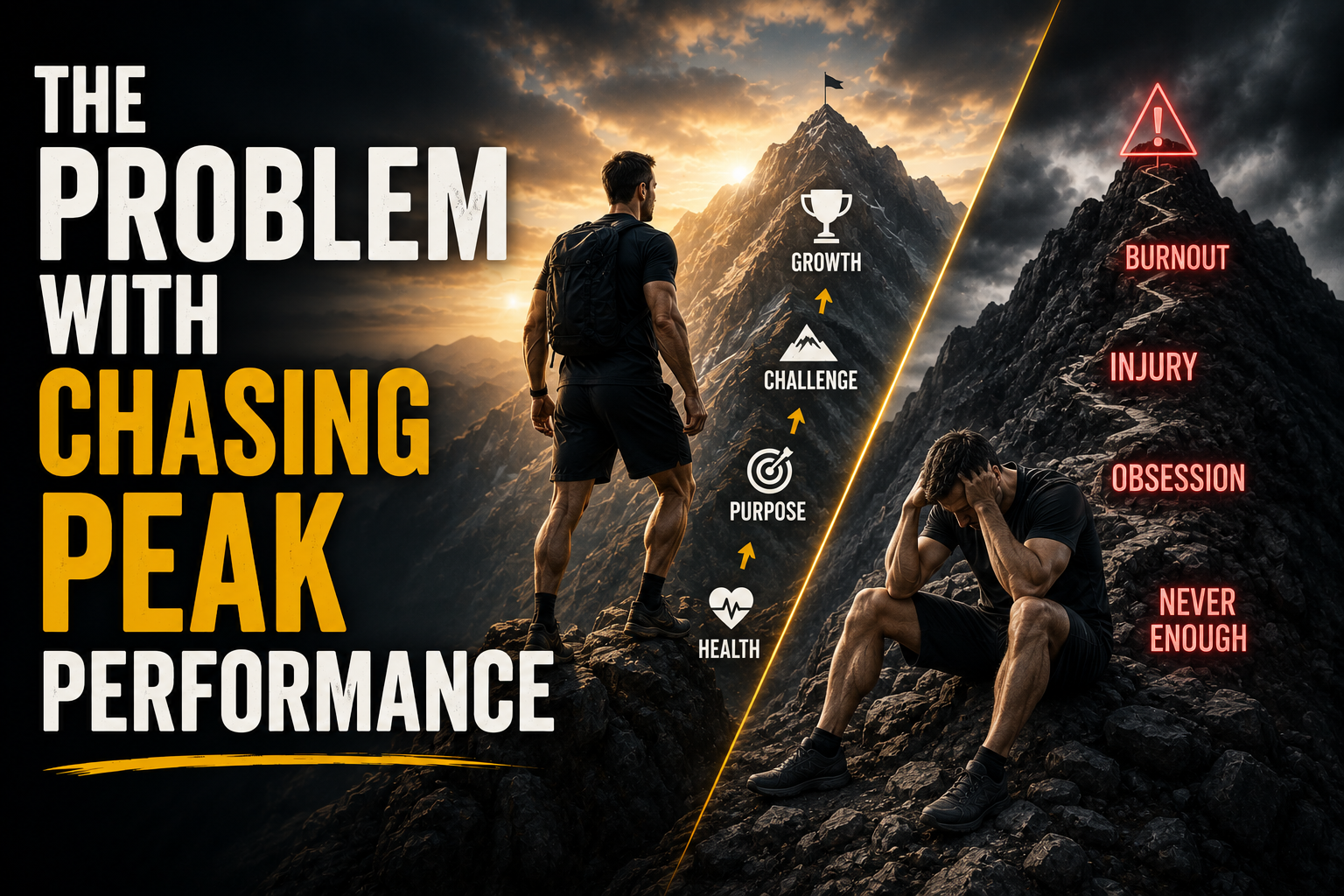
Build a Plateau, Not a Peak
Peak performance sounds impressive, but most adults do not need one extraordinary season. They need a high level of capability they can sustain for decades.
Why Peak Performance Is the Wrong Goal for Almost Every Adult
Imagine you're the CEO of a large manufacturing business.
Your operations director walks into the boardroom looking delighted.
"We've found a way to increase output by 15%."
The room smiles.
Then they continue.
The only downside is that every machine will now operate at 100% capacity, every day, with no downtime, no maintenance allowance and no contingency if something goes wrong.
The room falls silent.
No sensible executive would approve that proposal.
Every experienced leader understands that businesses need margin.
Machines require maintenance. People need holidays. Cash reserves provide security. Warehouses need spare capacity.
The best-run organisations are rarely those operating at their theoretical maximum.
They're the ones designed to survive reality.
Yet millions of intelligent adults manage their bodies using exactly the strategy no competent CEO would ever approve.
They chase maximum intensity.
Maximum optimisation.
Maximum output.
Maximum discipline.
Maximum sacrifice.
Every workout becomes a test. Every meal becomes a decision. Every week becomes an attempt to squeeze another one percent of performance from a system that is already running close to its limit.
Then they're surprised when something eventually breaks.
The problem isn't ambition.
The problem is the strategy.
The Peak Thinking Trap
Modern fitness has become obsessed with peaks.
Peak strength.
Peak conditioning.
Peak aesthetics.
Peak productivity.
Peak discipline.
Peak performance.
Everything is presented as a race towards some theoretical maximum version of yourself.
Social media reinforces this every day.
Transformation photos. Thirty-day challenges. Ninety-day programmes. Elite morning routines. Extreme calorie deficits. Two-hour workouts before sunrise.
The message is subtle but powerful:
If you're not operating at your maximum, you're underachieving.
I think that's one of the most damaging ideas in adult fitness.
Because life doesn't happen under laboratory conditions.
Life happens on four hours of sleep after a delayed flight.
It happens during redundancy consultations.
It happens while caring for young children.
It happens during illness, bereavement, deadlines and financial pressure.
The strategy that only works when life is perfect isn't an excellent strategy.
It's a fragile one.
Your Body Is Not a Formula One Car
Formula One cars are extraordinary machines.
For a brief period, they produce astonishing performance.
But they're designed for a very specific purpose.
Maximum speed.
Maximum output.
Maximum optimisation.
Between races they're rebuilt. Entire components are replaced. Teams of engineers analyse every detail. Millions of pounds are spent preserving performance.
Nobody expects a Formula One car to drive 250,000 miles carrying shopping and children to school.
Because that isn't its job.
Most adults, however, seem determined to treat their bodies like racing cars.
Every session should be harder than the last. Every lift should be heavier. Every run should be faster. Every diet should be stricter. Every plateau is viewed as failure. Every recovery week feels like weakness.
Eventually the engine overheats.
Then people conclude:
I just lack motivation.
Perhaps not.
Perhaps you've simply been trying to drive a Formula One car through everyday traffic.
The Operating Capacity Principle
Every well-managed organisation understands something called spare capacity.
Airlines don't schedule every aircraft to fly every minute of every day.
Data centres don't run every server permanently at full utilisation.
Electricity grids aren't designed to operate at maximum demand every hour.
Hospitals don't aim for every bed to be occupied forever.
Because intelligent systems are built with margin.
Margin creates resilience.
Margin absorbs uncertainty.
Margin allows recovery.
Your body deserves the same philosophy.
I call this the Operating Capacity Principle:
Train at a level that leaves room for life.
That doesn't mean avoiding hard work.
It means recognising that your workout is only one stressor among many.
Your body doesn't distinguish between heavy squats, difficult meetings, financial anxiety and poor sleep.
They're all deposits into the same physiological account.
If the account is constantly overdrawn, performance eventually declines.
Ironically, reducing your training from 100% to 85-90% often allows you to train more consistently, recover better and make greater long-term progress.
You're no longer optimising for today's session.
You're optimising for the next thousand.
The Ceiling Versus The Floor
Most people spend their entire fitness journey trying to raise their ceiling.
How much can I lift?
How fast can I run?
How lean can I become?
How hard can I push?
Those are interesting questions.
But I think there's a better one:
How good am I on an ordinary Tuesday?
Imagine two people.
Person A has incredible potential.
On their best day they're a 10/10.
But on a stressful week they become a 3.
They miss sessions. Their nutrition collapses. They stop sleeping well. They disappear from the gym for three weeks.
Person B is less spectacular.
Their absolute best might only be a 9.
But their worst day is still a 7.
Busy week?
They shorten the session.
Poor sleep?
They reduce intensity.
Work trip?
They walk more and maintain protein intake.
They never completely stop.
Which person wins after twenty years?
It's not even close.
The winner isn't the one with the highest ceiling.
It's the one with the highest floor.
Business leaders understand this instinctively.
They don't build organisations that occasionally perform brilliantly.
They build organisations that perform reliably under pressure.
Your body should be managed the same way.
The Highest Plateau Wins
People admire mountains because of their peaks.
But nobody can live on a peak.
The air is too thin.
The conditions are too hostile.
You visit the summit.
You don't build your life there.
Fitness works exactly the same way.
Perhaps you can reach your absolute peak for a competition.
For a photoshoot.
For a holiday.
For a sporting event.
That's perfectly reasonable.
But you cannot live there.
The objective for most adults should be something far more valuable:
Build the highest plateau possible.
Strong enough that everyday tasks feel easy.
Lean enough to feel healthy and confident.
Fit enough to play with your children.
Mobile enough to travel without discomfort.
Resilient enough that one stressful week doesn't undo months of progress.
That's not a compromise.
It's a strategy.
And unlike a peak, you can stay there for decades.
The Compound Interest of the Plateau
Perhaps the biggest mistake people make is assuming that fitness is won by extraordinary days.
It isn't.
It's won by ordinary ones.
Think about investing.
Imagine two investors.
The first invests aggressively.
They double their money in a short period.
Then panic during a market downturn and withdraw everything.
The second invests steadily.
Month after month.
Year after year.
They never make headlines.
Nobody admires their discipline because it looks boring.
Forty years later, they quietly retire wealthy.
The lesson is obvious.
Wealth is rarely built by spectacular moments.
It is built by thousands of ordinary decisions repeated consistently.
Your body follows exactly the same mathematics.
Most people remember the hardest workout they've ever done.
Your body doesn't.
Your body remembers what you repeatedly became.
Every session is a vote.
Every walk.
Every lift.
Every meal.
Every night's sleep.
Every recovery day.
Individually they seem insignificant.
Collectively they become your identity.
This is why the plateau wins.
You can only compound what you can repeat.
The Professional Athlete Problem
Social media has quietly convinced ordinary adults that they should evaluate themselves using the standards of professional athletes.
This makes no sense.
Imagine comparing yourself to a Formula One driver because you commute to work in a family hatchback.
The objectives are completely different.
Professional athletes are paid to maximise performance.
Their entire lives are organised around that objective.
Training. Recovery. Nutrition. Medical support. Massage. Sleep. Physiotherapy. Coaching. Monitoring.
Their job is performance.
Your job might be leading a business.
Managing people.
Raising children.
Travelling.
Looking after ageing parents.
Solving problems all day.
Then, after all that, you ask your body to perform like someone whose entire ecosystem exists to support recovery.
The comparison is unfair.
But more importantly, it's strategically wrong.
You don't need the body of someone preparing for one championship.
You need the body of someone preparing for everyday life.
That requires a different philosophy.
The 30-Year Athlete
I think adults need a new identity.
Not the weekend warrior.
Not the transformation participant.
Not the summer-body chaser.
The 30-Year Athlete.
The 30-Year Athlete isn't training for one event.
They're training for every event.
The airport.
The holiday.
The unexpected hike.
The stressful week at work.
The skiing trip.
The grandchildren.
The house move.
The charity walk.
The moment someone says:
Can you give me a hand?
The 30-Year Athlete understands that physical capability is not seasonal.
It is infrastructure.
Just as a business continuously maintains its IT systems, finances and operations, capable adults continuously maintain their bodies.
Sometimes progress is rapid.
Sometimes it's slow.
Sometimes maintenance is enough.
The objective is not constant acceleration.
The objective is avoiding unnecessary decline.
Raising Your Floor
Most people spend years trying to raise their ceiling.
I think they should spend more time raising their floor.
Your ceiling is what you can do on your very best day.
Your floor is what you can still do on your worst.
The ceiling impresses people.
The floor protects you.
Imagine someone who can deadlift 250kg but stops exercising every time work becomes stressful.
Now imagine someone who can deadlift far less but never misses more than a week of training.
Who will likely be healthier at sixty-five?
Who will probably remain more independent?
Who will have fewer long-term setbacks?
Consistency quietly raises the floor.
And once your floor rises high enough, your average becomes exceptional.
Business leaders understand this instinctively.
The greatest organisations are not those that occasionally deliver extraordinary quarters.
They're the ones that produce reliable excellence through recessions, uncertainty and change.
Your body should operate the same way.
Minimum Effective Excellence
One of the biggest misunderstandings in fitness is believing that the objective is maximum effort.
Maximum effort is a tool.
It is not the objective.
The objective is maximum long-term adaptation.
Sometimes that means pushing hard.
Sometimes it means backing off.
Sometimes it means replacing an hour-long workout with twenty focused minutes because life is demanding attention elsewhere.
Many ambitious people interpret this as lowering standards.
It's actually raising them.
You're no longer asking:
What's the hardest thing I can do today?
You're asking:
What's the smartest investment I can make today that keeps the system moving forward?
Great businesses don't maximise today's profit at the expense of tomorrow.
They invest.
Your body deserves the same treatment.
The Body That Life Can Depend On
Imagine yourself twenty-five years from now.
Nobody asks whether you once achieved ten percent body fat.
Nobody asks what your deadlift personal best was.
Nobody asks how many calories you burned during an exceptional training week in your forties.
Life asks different questions.
Can you travel comfortably?
Can you lift your luggage?
Can you play with your grandchildren?
Can you climb the stairs?
Can you help someone else?
Can you recover after illness?
Can you remain independent?
Those are capability questions.
And capability is built through repetition.
Not perfection.
The strongest people are often not those who trained the hardest.
They're the ones who simply never stopped.
Final Thoughts
People admire mountains because of their peaks.
But nobody builds a home on the summit.
It's too exposed.
Too unpredictable.
Too difficult to sustain.
Instead, people build where life can flourish.
Fitness should be approached the same way.
Your objective is not one extraordinary summer.
Not one transformation photograph.
Not one personal best.
Not one period where everything aligns perfectly.
Your objective is to build the highest plateau possible.
Strong enough that everyday life feels easier.
Fit enough that opportunities become invitations instead of obstacles.
Resilient enough that stressful weeks no longer derail months of progress.
Because your body won't become the person you were on your best day.
It will become the average of the thousands of days you were able to repeat.
So stop asking:
How can I reach my peak?
Ask a better question:
How can I build a plateau that lasts for decades?
Because in business, investing and fitness, the winners are rarely those who reach the highest peak.
They're the ones who quietly stay at a high level long after everyone else has come back down.