
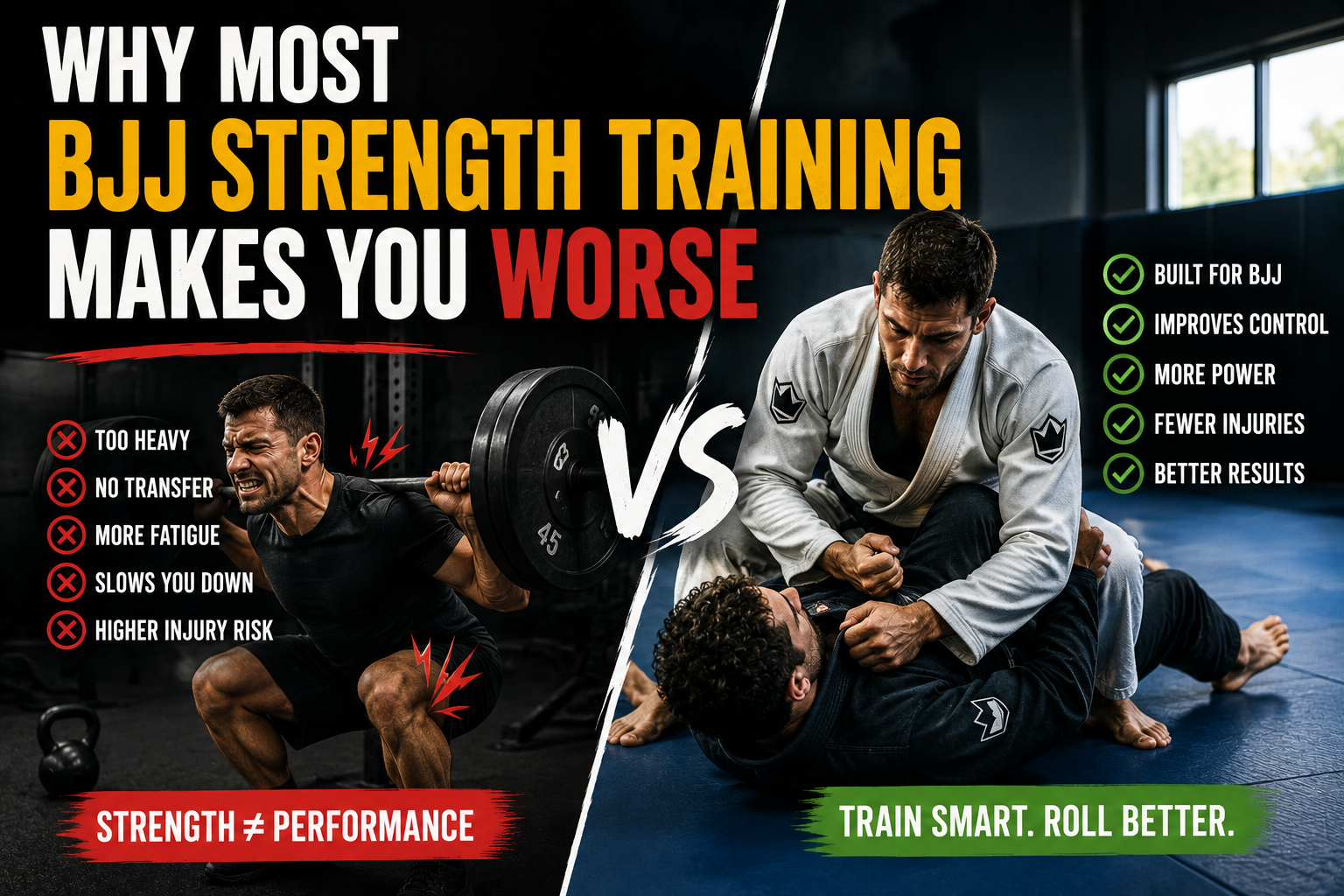
Why Most BJJ Strength Training Makes You Worse
The gym should improve your jiu-jitsu, not compete with it. Strength training works best when it develops the physical qualities that allow skill to be expressed more effectively under pressure, fatigue, and resistance.
Walk into almost any commercial gym and you'll see grapplers making one of two mistakes.
The first group barely strength trains at all.
They're worried lifting weights will make them slower. Less mobile. Too sore to train. They assume that every kilogram they add to the bar somehow takes something away from their jiu-jitsu.
The second group goes to the opposite extreme.
The gym slowly becomes a second sport.
They obsess over squat numbers.
They spend hours debating whether chains are superior to bands. Whether low-bar squats outperform front squats. Whether they should use percentages, velocity trackers or accommodating resistance.
Eventually, they become very good at lifting weights.
Unfortunately, their jiu-jitsu doesn't improve at the same rate.
In some cases, it actually gets worse.
Both groups have misunderstood the role of strength training.
The first underestimates its value.
The second overestimates its importance.
The truth sits somewhere in the middle.
Strength training should never become the main event.
It should become one of the highest-value supporting systems in an athlete's development.
The gym exists for one reason:
To make your jiu-jitsu easier to express under pressure.
Nothing more.
Nothing less.
Strength training should make you harder to sweep.
Harder to move.
More explosive in scrambles.
More resilient under fatigue.
More durable over years of training.
If your gym programme improves your deadlift but leaves you too sore to train, constantly fatigued, or recovering from avoidable injuries, it has failed in its primary purpose.
The weights should never compete with the art.
They should support it.
Everything else in this article flows from that single idea.
Don't Major in the Minors
One of the best pieces of advice I ever received had nothing to do with sport.
It was simply:
Don't major in the minors.
In other words, don't spend enormous amounts of energy optimising things that have very little influence on the final outcome.
Ironically, strength training has become full of exactly this behaviour.
Spend ten minutes on social media and you'll find endless arguments about:
- Which deadlift variation has the greatest transfer to grappling.
- Whether chains outperform resistance bands.
- The "perfect" rep range for athletes.
- The ideal rest period.
- Whether you should squat barefoot.
- Which grip width produces the greatest force output.
- Whether tempo prescriptions improve athletic performance.
None of these questions are completely unimportant.
But none of them are the questions most athletes should be asking first.
Imagine two competitors preparing for the World Championships.
The first spends hours every week debating whether box squats have more transfer than safety-bar squats.
The second sleeps eight hours every night, rolls consistently, strength trains three times per week, eats enough protein, avoids unnecessary fatigue and gradually becomes stronger over several years.
Who wins?
Almost certainly the second athlete.
Not because they discovered the perfect exercise.
Because they consistently improved the qualities that actually matter.
The uncomfortable truth is that most athletes don't have an exercise selection problem.
They have a priorities problem.
The biggest gains rarely come from optimising the final 5%.
They come from repeatedly executing the foundational 95%.
The question shouldn't be:
"Which exercise is best?"
It should be:
"What qualities am I actually trying to develop?"
That single change in thinking alters everything.
The Hierarchy of Athletic Development
One of the most common mistakes in strength training is trying to develop advanced athletic qualities before building the body capable of expressing them.
Everyone wants to become more explosive.
Very few people ask whether they have earned the right to train explosively in the first place.
Physical development works like building a house.
Nobody installs a roof before pouring foundations.
Nobody hangs expensive kitchen cabinets before the walls exist.
Yet athletes do exactly that every day.
They buy advanced programming.
Plyometric courses.
Velocity trackers.
Complex accommodating resistance systems.
All before building the physical base that allows those methods to work.
Athletic development is far more logical than that.
It progresses in layers.
At the bottom sits General Physical Preparedness (GPP).
This is the quality almost nobody talks about because it isn't glamorous.
Nobody posts their GPP on Instagram.
But without it, everything else becomes fragile.
General Physical Preparedness simply means having a body that is capable of training consistently.
Can your joints tolerate volume?
Can your connective tissues recover?
Can you complete difficult training weeks without falling apart?
Can you return tomorrow and perform again?
Can you accumulate months and years of productive practice?
That's GPP.
It's less about winning today and more about remaining available to improve tomorrow.
Once that foundation exists, attention turns towards General Strength.
Strength is often misunderstood.
People think strength simply means lifting heavier weights.
It doesn't.
Strength is reserve.
Imagine two athletes.
One can deadlift 120kg.
The other can deadlift 220kg.
Now both athletes need to lift an opponent whose effective resistance is roughly equivalent to 80kg.
For the first athlete, that's close to two-thirds of their maximum strength.
For the second athlete, it's barely more than one-third.
Exactly the same physical task feels dramatically different.
This is why stronger athletes often appear calmer.
Movements require less of their available capacity.
Reserve creates options.
Reserve delays fatigue.
Reserve increases resilience.
Reserve allows technique to survive when everyone else begins compensating.
Only after those two layers exist should we become concerned with sport-specific strength qualities.
Now we can begin asking more interesting questions.
How quickly can you produce force?
Can you maintain posture under pressure?
How effective is your grip?
How well can you stabilise on one leg?
Can you repeatedly produce explosive efforts without significant drop-off?
These qualities determine how effectively general strength is expressed during grappling.
| Level | Objective |
|---|---|
| Sport-Specific Strength Attributes | Develop explosive strength, grip strength, rate of force development, isometric strength, rotational control and repeated power. |
| General Strength | Increase the amount of force your body is capable of producing while creating greater physical reserve. |
| General Physical Preparedness (GPP) | Build a body capable of tolerating training, recovering consistently and remaining available for long-term progress. |
Skip the bottom layers and the top becomes unstable.
Build the foundations properly and every advanced quality becomes easier to develop.

Why Bodybuilding Splits Often Miss the Point
If there is one lesson that changed how I programmed athletes, it wasn't a new exercise.
It was understanding the difference between training muscles and training movement.
Traditional bodybuilding programmes are exceptionally good at one thing:
Growing muscle.
That is exactly what they were designed to do.
A typical split often looks something like this:
| Day | Primary Focus |
|---|---|
| Monday | Chest |
| Tuesday | Back |
| Wednesday | Shoulders |
| Thursday | Arms |
| Friday | Legs |
Each session completely exhausts one area of the body before moving onto the next.
For bodybuilding, this makes perfect sense.
The objective is muscular development.
Maximum local fatigue.
Maximum hypertrophy.
Maximum visual change.
Athletes, however, have a completely different objective.
They aren't trying to build the biggest chest.
They're trying to become better at expressing force.
Those are not the same goal.
Think about learning an armbar.
Would you practise it once every seven days for three hours?
Or would you practise it several times every week?
Almost every coach would choose the second option.
Because skill improves through repeated exposure.
Strength behaves remarkably similarly.
Strength isn't just a physical quality.
It's also a neurological skill.
Every repetition teaches the nervous system to coordinate muscles more efficiently, recruit motor units more effectively and apply force with greater precision.
The more frequently you expose the nervous system to high-quality movement, the more opportunities it has to improve.
Now compare two athletes.
Athlete A performs twenty sets of chest exercises every Monday.
By Tuesday they can barely straighten their arms.
Their pressing pattern isn't trained again until the following week.
Athlete B performs one primary pressing movement twice every week.
The volume per session is lower.
Recovery is easier.
Technique stays cleaner.
Movement quality remains high.
Who becomes stronger over the next two years?
Almost always Athlete B.
Because they accumulate far more quality practice.
This doesn't mean bodybuilding training is wrong.
It simply means it's solving a different problem.
Bodybuilders optimise muscular fatigue.
Athletes optimise long-term adaptation.
Those objectives sometimes overlap.
But they are not identical.
Recognising that difference is one of the biggest shifts an athlete can make.
Because once you stop asking:
"Which muscles am I training today?"
You start asking:
"Which athletic qualities am I trying to improve?"
That question naturally leads to one of the biggest programming decisions every athlete has to make.
If bodybuilding-style programming isn't the answer for most grapplers...
...how should those physical qualities actually be developed?
A Better Way to Think About Strength Training
By now we've established two important ideas.
First, the gym exists to support your jiu-jitsu, not compete with it.
Second, athletes should train physical qualities, not simply chase bigger muscles or harder workouts.
The next question is obvious.
If bodybuilding-style programming isn't the answer, how should a grappler organise strength training?
To answer that, we first need to understand why the most common strength programming model became so popular in the first place.
Why Traditional Periodisation Works... Until It Doesn't
If you've ever picked up a strength and conditioning textbook, chances are you've come across the concept of periodisation.
At its simplest, periodisation is nothing more than the planned organisation of training over time.
Rather than trying to improve every physical quality simultaneously, the coach deliberately shifts the emphasis throughout the training year.
A traditional linear model might look something like this:
| Phase | Primary Focus |
|---|---|
| Accumulation | Build muscle and work capacity |
| Strength | Increase maximal force production |
| Power | Convert strength into speed |
| Peaking | Reduce fatigue and maximise performance |
The logic is extremely sensible.
First, build a bigger engine.
Then make the engine stronger.
Then teach it to produce force more quickly.
Finally, remove enough fatigue for the athlete to perform at their best when competition arrives.
For many sports, this approach works exceptionally well.
Imagine you're coaching an Olympic weightlifter.
They know exactly when they need to perform.
The competition calendar is predictable.
Training can be planned months in advance.
Volume gradually decreases.
Intensity gradually increases.
Fatigue is carefully managed until competition day arrives.
The same principle applies to powerlifting, athletics and many other individual sports with clearly defined competition seasons.
The training calendar is relatively stable.
The objective is clear.
Peak on one specific day.
When the environment is predictable, linear periodisation makes perfect sense.
The problem isn't that linear periodisation is wrong.
The problem is that BJJ isn't linear.
Why Grapplers Live in a Different World
Very few grapplers enjoy the luxury of a predictable training year.
Even athletes preparing for the World Championships are rarely doing just one thing.
They're rolling three or four nights each week.
They're drilling techniques.
Teaching classes.
Working full-time.
Travelling.
Recovering from minor injuries.
Managing family commitments.
Trying to sleep enough.
Some weeks are technical.
Others become wars.
One training partner flows.
The next wants every round to feel like the final of the ADCC.
Training stress changes constantly.
Life changes constantly.
Recovery changes constantly.
Now imagine telling a grappler:
"For the next six weeks we're only going to build muscle."
What happens to their explosiveness?
What happens to their maximal strength?
What happens to their ability to produce force quickly?
Or imagine spending six weeks focused entirely on power.
Does absolute strength suddenly stop mattering?
Of course not.
The demands of grappling don't arrive in neat blocks.
A single scramble might require explosive power, maximal strength, grip endurance, isometric control and muscular endurance within the space of ten seconds.
The body doesn't experience these qualities one after another.
It experiences them simultaneously.
That changes everything.
Instead of asking:
"Which quality should I train this month?"
The better question becomes:
"How do I keep developing multiple qualities without allowing any of them to disappear?"
That question naturally leads us towards a conjugate-inspired approach.
Why Conjugate Principles Make Sense for Grapplers
When most people hear the word conjugate, they immediately think of Westside Barbell.
Bands.
Chains.
Box squats.
Powerlifting.
That's understandable.
But it also misses the most valuable lesson Louie Simmons left behind.
Conjugate isn't really about equipment.
It isn't about fancy exercise variations.
It certainly isn't about trying to turn grapplers into powerlifters.
At its core, conjugate is simply a philosophy.
Train multiple physical qualities concurrently while rotating exercises just enough to keep adaptation moving forwards.
That single sentence explains almost everything.
The exercises are simply tools.
The philosophy is what matters.
Because if grapplers need multiple physical qualities available throughout the year, then it makes sense to continue exposing those qualities throughout the year.
Not equally.
Not randomly.
But consistently.
This doesn't mean trying to improve everything at once.
It means refusing to completely abandon one quality while chasing another.
That's a subtle but important distinction.
Good conjugate programming isn't random.
It's remarkably organised.
Movement patterns remain surprisingly consistent.
The specific exercises change.
Bench press becomes incline bench.
Incline becomes close-grip.
Close-grip becomes floor press.
The movement family stays the same.
The stimulus changes just enough to keep progress moving.
It's organised variation.
Not random variation.
The Three Questions Every Programme Must Answer
One of the biggest breakthroughs in my own coaching came when I stopped thinking about exercises first.
Instead, I started asking three simple questions.
Can the athlete produce more force?
Can they produce that force faster?
Can they repeat that force reliably over time?
Almost every physical quality a grappler needs fits underneath one of those three questions.
Those questions eventually became the foundation of every programme I wrote.
Question One — Can They Produce More Force?
This is the purpose of the Max Effort Method.
Maximum strength creates reserve.
Reserve changes everything.
Imagine two athletes attempting exactly the same bridge escape.
One athlete squats 120kg.
The other squats 220kg.
Neither athlete is producing maximal force during the movement.
But the stronger athlete is using a much smaller percentage of their available strength.
Exactly the same task feels easier.
Reserve creates options.
Reserve delays fatigue.
Reserve improves posture.
Reserve allows technique to survive under increasing pressure.
One of the biggest misconceptions about max effort work is that athletes should constantly chase one-repetition maximums.
For most grapplers, that's unnecessary.
Heavy triples.
Heavy fives.
Heavy sets performed with excellent technique.
These develop absolute strength extremely effectively while keeping recovery costs manageable.
Remember...
The objective isn't to become exceptional at lifting weights.
The objective is to make grappling feel physically easier.
Question Two — Can They Produce Force Faster?
Being strong isn't enough.
Strength delayed is strength unavailable.
When somebody explodes into a double-leg, you don't have three seconds to gradually build force.
You need it immediately.
The same applies to:
- Hip escapes.
- Bridges.
- Grip breaks.
- Direction changes.
- Wrestling exchanges.
- Explosive scrambles.
The athlete who produces meaningful force first often controls the exchange.
This is where Rate of Force Development (RFD) becomes so important.
One of the biggest misconceptions about speed work is believing it exists to make the exercise easier.
It doesn't.
Speed work is neurological training.
Every explosive repetition teaches the nervous system to recruit motor units more efficiently.
Muscle fibres don't slowly warm up one by one.
They're switched on through increasingly effective neural signalling.
Training with maximal intent improves both:
Intramuscular coordination — how effectively fibres within one muscle work together.
Intermuscular coordination — how effectively multiple muscles coordinate to produce movement.
Over time, this allows force to be produced faster.
Notice that the emphasis isn't the weight.
It's the intent.
Whether you're performing speed bench, plyometric press-ups or box jumps, every repetition should be attacked with maximum intent.
That's why recovery between sets matters.
If fatigue becomes too high, bar speed drops.
Movement quality changes.
The nervous system begins practising slower movement.
At that point, you've stopped training speed.
You've started practising fatigue.
Dynamic effort work is quality practice.
Not conditioning.
Question Three — Can They Repeat That Force Reliably?
The final question often receives the least attention.
Ironically, it's probably where athletes spend the most time.
This is the Repetition Effort Method.
This is where the body gets built.
Rows.
Pull-ups.
Romanian deadlifts.
Split squats.
Rear delts.
Grip work.
Neck work.
Trunk stability.
None of these exercises will win you the World Championships on their own.
Collectively, however, they create an athlete capable of training consistently for years.
This is where muscle is built.
Connective tissue becomes stronger.
Weak links improve.
Structural balance develops.
Joint health improves.
The repetition effort method isn't glamorous.
It won't generate viral training videos.
But it quietly solves many of the problems that eventually stop athletes progressing.
Longevity is built here.
And longevity compounds.
Training Is Practice, Not Punishment
One of the biggest mistakes athletes make is confusing fatigue with progress.
They leave the gym exhausted and assume it must have been a productive session.
Professional athletes tend to think differently.
They ask a much better question.
Did today's session improve tomorrow's performance?
That is all that really matters.
The gym isn't there to entertain you.
It isn't there to punish you.
And it certainly isn't there to prove how mentally tough you are.
Every repetition is practice.
Practice for producing force.
Practice for coordinating movement.
Practice for maintaining posture.
Practice for expressing strength more efficiently.
Once you begin thinking this way, many common mistakes disappear.
You stop chasing failure.
You stop adding unnecessary volume.
You stop confusing soreness with progress.
Instead, every exercise has a purpose.
Every session develops a quality.
Every quality supports the sport.
Because the gym was never supposed to become the sport.
It exists to help you perform your sport better.
And that brings us to the next challenge.
Even the smartest programme in the world fails if the athlete cannot recover from it.
Making Strength Training Sustainable
By this point we've established a philosophy.
We've discussed why grapplers need multiple physical qualities, how those qualities can be developed concurrently, and why the gym should exist to support performance rather than compete with it.
Unfortunately, this is where many well-designed programmes still fail.
Not because the exercises are wrong.
Not because the science is wrong.
But because they ignore one unavoidable reality.
Every training decision has a recovery cost.
The best programme on paper is worthless if the athlete cannot recover from it.
Ultimately, strength training isn't simply about what your body is capable of doing.
It's about what your body is capable of recovering from.
That distinction separates intelligent programming from simply writing hard workouts.
There Is Only One Recovery Account
One of the biggest mistakes grapplers make is treating recovery as though it exists in separate compartments.
They think there is one recovery account for jiu-jitsu.
Another for lifting.
Another for work stress.
Another for sleep.
Another for dieting.
Another for travelling.
But the body doesn't work like that.
There is only one account.
Everything withdraws from it.
Hard sparring withdraws from it.
Heavy squats withdraw from it.
Poor sleep withdraws from it.
Long working hours withdraw from it.
Arguments at home withdraw from it.
Travelling withdraws from it.
A calorie deficit withdraws from it.
Minor injuries withdraw from it.
Even psychological stress withdraws from it.
The body doesn't care where the stress came from.
It simply responds to the total amount placed upon it.
This is one of the biggest reasons strength programmes fail outside the laboratory.
On paper, the programme looks perfect.
The sets make sense.
The reps make sense.
The exercises make sense.
The progression model is sensible.
But the athlete isn't living on paper.
They're living in the real world.
They're balancing careers.
Families.
Financial pressure.
Poor sleep.
Business travel.
Hard rounds.
Minor injuries.
The programme hasn't changed.
The athlete has.
And good coaching recognises that.
Imagine two identical athletes following exactly the same programme.
One is twenty-two years old.
Single.
Sleeping nine hours.
Training full-time.
The other is thirty-eight.
Runs a business.
Has two children.
Sleeps six hours.
Travels twice per month.
Coaches evening classes.
Should they perform the same amount of training?
Of course not.
Because the recovery budget isn't the same.
This is where mature coaching differs from simply writing spreadsheets.
Every gym session should be judged by one question:
Does this improve the athlete's ability to train and perform overall?
Not...
Did the session feel difficult?
Did it create a huge pump?
Did it produce impressive soreness?
Did it look good on Instagram?
None of those questions matter.
The only question that matters is whether the adaptation created is worth the recovery cost required to earn it.
That is the lens through which every training decision should be viewed.

Stop Training to Failure
Training to failure is emotionally satisfying.
It feels productive.
It feels disciplined.
It feels like you've earned the right to improve.
Unfortunately, physiology doesn't always reward feelings.
Athletes often assume that because failure creates more fatigue, it must also create more progress.
That simply isn't true.
Especially for someone whose primary objective isn't bodybuilding.
Failure is expensive.
Every repetition performed after technique begins to deteriorate carries a cost.
Fatigue rises.
Recovery demands increase.
Movement quality deteriorates.
Injury risk increases.
And perhaps most importantly...
Tomorrow's jiu-jitsu session often suffers.
Remember the principle we established in Act One.
The gym exists to improve your jiu-jitsu.
Not replace it.
Not compromise it.
Improve it.
That changes how we should think about effort.
For bodybuilders, local muscular fatigue is often the objective.
For athletes, adaptation is the objective.
Those are not the same thing.
One useful rule I've followed for years is remarkably simple:
Finish the set while the movement still looks like the movement you intended to train.
That doesn't mean avoiding hard work.
It means recognising that quality is a skill.
When fatigue becomes excessive, the body becomes incredibly creative.
The hips shift.
The shoulders compensate.
The spine moves differently.
The bar path changes.
The nervous system doesn't know what you intended to practise.
It only knows what you repeatedly performed.
If you consistently practise ugly repetitions, you become more efficient at producing ugly repetitions.
If you consistently practise powerful, technically sound repetitions, you become more efficient at expressing force through high-quality movement.
For an athlete, that's the adaptation we're looking for.
The gym is practice.
Not punishment.
The Law of Diminishing Gym Returns
One of the hardest lessons for ambitious athletes to accept is that more eventually stops meaning better.
Early strength gains transform grapplers.
The athlete who increases their squat from 100kg to 150kg usually feels very different on the mat.
They're harder to move.
Harder to flatten.
More confident in scrambles.
More stable under pressure.
They possess greater physical reserve.
But those improvements don't continue forever.
The difference between a 220kg squat and a 240kg squat is rarely as meaningful for a grappler as the difference between 100kg and 120kg.
The recovery cost, however, often continues increasing.
This is what I call The Law of Diminishing Gym Returns.
Every additional kilogram eventually becomes more expensive to earn.
Yet often produces less sporting benefit.
This creates a trap.
Because gym progress is addictive.
It's measurable.
Clean.
Objective.
The bar either moved or it didn't.
Your personal best either increased or it didn't.
Jiu-jitsu doesn't provide feedback that neatly.
You can improve enormously and still lose rounds.
You can make better decisions and still get caught.
Technical progress is often subtle.
Strength progress feels obvious.
That makes the gym psychologically rewarding.
Over time, many athletes unknowingly begin chasing gym numbers rather than sporting performance.
The gym quietly becomes the sport.
Exactly the mistake we discussed in Act One.
This doesn't mean pursuing strength is unimportant.
Far from it.
Strength remains one of the most valuable physical qualities a grappler can develop.
The mistake is forgetting why we wanted it in the first place.
Strength is valuable because it improves jiu-jitsu.
Not because the spreadsheet looks impressive.
Every strength goal should eventually answer one question:
Will this make me a more difficult person to grapple with?
If the answer becomes uncertain...
The return on investment is probably shrinking.
Confidence Is the Product. Fatigue Is the Cost.
One of the biggest shifts in my coaching came when I stopped judging sessions by how tired athletes looked.
Instead, I started asking:
How should they feel when they leave the gym?
The answer wasn't exhausted.
It wasn't broken.
It wasn't crawling to the car.
The answer was confident.
A great strength session should leave an athlete thinking:
I feel stronger. Faster. More prepared.
Not...
I hope I can survive tomorrow's training.
Fatigue creates the feeling of hard work.
Confidence creates the capacity to perform.
Those are very different outcomes.
A brutal session often satisfies the ego because suffering feels productive.
But adaptation doesn't care how dramatic the workout felt.
The body only cares whether the stimulus was appropriate.
The best programmes create the greatest useful adaptation with the least unnecessary fatigue.
Especially for athletes already accumulating enormous stress through their sport.
Remember...
The mats already provide plenty of intensity.
The weight room doesn't need to compete in the suffering business.
Its job is to quietly build the physical qualities that make suffering easier to tolerate when it actually matters.
Freshness Beats Fitness
The closer competition approaches, the more important this lesson becomes.
Many athletes panic.
Competition is approaching.
They feel they need to squeeze more work into the remaining weeks.
More conditioning.
More lifting.
More rolling.
More drilling.
More everything.
But competition preparation isn't about proving how fit you are.
It's about allowing your fitness to appear.
There is an enormous difference.
Training builds qualities.
Recovery reveals them.
An athlete buried beneath accumulated fatigue cannot express the physical qualities they've spent months developing.
They're strong.
But slow.
Fit.
But flat.
Explosive.
But constantly sore.
The final weeks before competition aren't about creating dramatic new adaptations.
They're about removing unnecessary fatigue while preserving the qualities that already exist.
Keep intensity.
Reduce unnecessary volume.
Maintain speed.
Avoid unnecessary soreness.
Protect confidence.
The objective isn't to arrive feeling like you've worked harder than everyone else.
The objective is to arrive capable of expressing everything you've already built.
Freshness doesn't replace fitness.
It reveals it.
The Real Standard
Throughout this article we've discussed exercises.
Programming.
Recovery.
Strength.
Speed.
Fatigue.
Variation.
But every coaching decision eventually comes back to one simple question.
Does this improve performance on the mat?
Not theoretically.
Practically.
Does the athlete recover better?
Do they maintain posture longer?
Do they produce force faster?
Are they more difficult to move?
Can they train more consistently?
Can they express their technique more effectively under fatigue?
If the answer is yes...
The programme is doing its job.
If the answer is no...
Something needs to change.
Maybe the volume is too high.
Maybe recovery is insufficient.
Maybe the exercise selection is poor.
Maybe the athlete is chasing numbers that no longer transfer meaningfully to performance.
The answer will vary.
The principle never changes.
The gym exists to support the art.
Never compete with it.
And that leaves just one final question.
If these principles are worth following...
What does a programme built around them actually look like?
Applying the Principles: Building a Programme That Serves the Sport
By this point we've covered a lot of theory.
We've discussed priorities.
We've explored why athletes should train physical qualities rather than simply chase bigger muscles.
We've looked at why a conjugate-inspired approach suits grappling, and why recovery ultimately determines whether any programme succeeds.
The final question is obvious.
What does all of this actually look like in practice?
Before answering that, there's one final mindset shift worth making.
Don't think like someone following a programme.
Think like the coach writing one.
Because programmes eventually change.
Life changes.
Equipment changes.
Injuries happen.
Training schedules evolve.
The principles don't.
If you understand the principles, you can rebuild the programme whenever circumstances change.
If you only understand the programme itself, you're dependent on somebody else writing the next one.
Every Session Begins With One Question
Every session should begin by asking:
What is the primary physical quality I want to improve today?
Not...
What muscles am I training?
Not...
What exercise haven't I done recently?
Not...
What do I feel like doing today?
Instead:
What quality deserves my freshest body and my highest concentration?
Everything else in the session exists to support that answer.
That's why every training day begins with one primary movement.
That movement receives your freshest nervous system.
Your greatest intent.
Your highest technical quality.
Everything afterwards becomes repetition effort work designed to build the body that supports that quality.
This keeps the programme remarkably simple.
One priority.
Everything else supports it.
Build Around Movement Families, Not Individual Exercises
One of the biggest mistakes athletes make is becoming emotionally attached to individual exercises.
"I've always bench pressed."
"I don't like front squats."
"I only feel strong when I deadlift."
The body doesn't think like that.
It recognises movement.
Not exercise names.
Instead of chasing one lift forever, think in movement families.
Horizontal Press
- Bench Press
- Incline Bench Press
- Close-Grip Bench Press
- Floor Press
- Chain Bench Press
Squat
- Back Squat
- Safety Bar Squat
- Front Squat
- Pause Squat
- Box Squat
Hip Hinge
- Trap Bar Deadlift
- Romanian Deadlift
- Conventional Deadlift
- Rack Pull
- Good Morning
You're not abandoning the movement.
You're simply changing the expression of it.
That small amount of variation provides fresh stimulus while maintaining enormous transfer.
The Three-Week Wave
Once you've selected your primary movement, stay with it.
Don't change next week because Instagram showed you something different.
Allow the body time to adapt.
A simple three-week wave works extremely well.
| Week | Prescription | Objective |
|---|---|---|
| 1 | 3 × 7 | Build quality volume and reinforce movement |
| 2 | 4 × 5 | Increase force production |
| 3 | 6 × 3 | Express higher force with technically perfect repetitions |
Notice what doesn't change.
The exercise.
If Week One begins with the bench press...
Week Two is still bench press.
Week Three is still bench press.
Only after completing the wave do you rotate to another exercise within the same movement family.
Bench Press.
↓
Incline Bench Press.
↓
Close-Grip Bench Press.
↓
Floor Press.
↓
Back to Bench Press.
Variation exists to prevent stagnation.
Not to entertain boredom.
The Blueprint Behind Every Session
Regardless of whether you're training upper body, lower body, maximal strength or speed, every session follows exactly the same structure.
Step One
Choose the quality you're trying to improve.
Strength?
Explosiveness?
Speed?
Step Two
Choose one primary movement that develops that quality.
This is Exercise One.
It always comes first.
It always receives your highest quality effort.
Step Three
Build the body around that movement.
Everything else becomes repetition effort work.
Not random accessory exercises.
Purposeful structural development.
Every exercise should answer one question:
How does this make my primary movement stronger or my body more resilient?
Max Effort Upper Body
Primary Quality: Absolute Strength
Exercise One: Choose one movement from your horizontal pressing family.
Remain with that movement for the entire three-week wave.
- Bench Press
- Incline Bench Press
- Floor Press
- Close-Grip Bench Press
- Chain Bench Press
Once your primary work is complete, build the body around it.
Exercise Two: Supplementary Press — 4 × 8–12
- Dumbbell Bench Press
- Incline Dumbbells
- Weighted Dips
- Machine Press
Exercise Three: Horizontal or Vertical Pull — 4 × 8–12
- Pull-Ups
- Chest Supported Rows
- Seal Rows
- Barbell Rows
Exercise Four: Shoulder Health — 3–4 × 12–20
- Face Pulls
- Reverse Flyes
- External Rotation
- Band Pull-Aparts
Exercise Five: Arms — 3–4 × 10–15
Strong elbows tolerate training.
Healthy arms protect healthy shoulders.
Max Effort Lower Body
The structure never changes.
Only the movement pattern does.
Exercise One: Choose one squat or hinge variation.
Remain with it for the full wave.
- Safety Bar Squat
- Front Squat
- Trap Bar Deadlift
- Pause Squat
- Box Squat
Then build the body around it.
Exercise Two: Posterior Chain — 4 × 8–12
- Rack Pulls
- Snatch Grip Deadlifts
- Romanian Deadlifts
- Glute-ham Raise
- Hyperextensions
- Reverse Hyperextensions
Exercise Three: Single-leg strength — 4 × 8–12
- Bulgarian Split Squats
- Lunge Variations
- Step-up Variations
- Single-leg Leg Press
Exercise Four: Core strength — 4 × 8–12
- Hanging Leg Raises
- Renegade Rows
- Paloff Press
- Cable Woodchops
Exercise Five: Grip strength — 4 × max time or distance
- Farmer's Walk
- Dead Hang (Gi/ Towel)
- Rope Climbs
- Plate Pinches
The objective isn't to perform as many exercises as possible.
The objective is to leave no important physical quality neglected.

Dynamic Effort Days
The blueprint remains exactly the same.
Only Exercise One changes.
Instead of asking:
How much force can I produce?
We're asking:
How quickly can I produce it?
Upper body options include:
- Speed Bench
- Banded Bench
- Chain Bench
- Plyometric Press-Ups
Lower body options include:
- Box Jumps
- Broad Jumps
- Squat Jumps
- Bounds
- Trap Bar Jumps
Every repetition should be explosive.
Every repetition should be intentional.
The moment speed noticeably slows...
The quality you're trying to train has disappeared.
Rest longer.
Reduce the load.
Protect movement quality.
Because speed work isn't conditioning.
It's skill practice for the nervous system.
Adapt the Structure, Not the Principles
Many athletes immediately ask:
"So should I train three days or four?"
That's the wrong question.
Ask instead:
How much training can I recover from while continuing to improve on the mats?
Everything flows from there.
Four-Day Split
Ideal if recovery is excellent.
- Max Effort Upper
- Max Effort Lower
- Dynamic Effort Upper
- Dynamic Effort Lower
Each quality receives dedicated attention.
Three-Day Split
Probably the best option for most competitors.
Simply perform your plyometrics before your max effort lower-body movement.
You preserve explosive work without adding another gym day.
Three-Day Full Body
Ideal for busy professionals.
Combine upper and lower dynamic work into one session.
Reduce accessory volume.
Maintain movement quality.
Protect recovery.
Notice something important.
The principles never changed.
Only the organisation changed.
The Smart Way to Add More Training Volume
As athletes gain experience, they often begin asking the same question.
"How can I do more?"
It's a fair question.
Perhaps your upper back feels like it could tolerate more work. Perhaps your grip is becoming a limiting factor late in rounds. Perhaps your neck, trunk or shoulders would benefit from additional attention.
The temptation is to immediately add another exercise. Another training day. Another conditioning session.
Sometimes that's appropriate.
More often, it isn't.
Remember one of the central ideas from this article:
Every training decision carries a recovery cost.
The goal isn't to perform the most work possible.
The goal is to perform the greatest amount of useful work that you can consistently recover from.
Those are very different objectives.
For most grapplers, the smartest place to increase training volume isn't by adding more heavy compound lifts.
It's by making the existing session more efficient.
Protect the Priority
Every workout in this programme begins with one question.
What is today's primary physical quality?
That first exercise deserves your freshest nervous system, your highest concentration and your best effort.
Nothing should compromise it.
Once that work is complete, however, you have much more flexibility.
This is where accessory work becomes incredibly valuable.
Accessory exercises exist to build the body around the primary movement. They improve structural balance, address weak links, build muscle, increase resilience, protect joints and improve longevity.
Unlike your primary lift, accessory exercises rarely need your absolute concentration.
That makes them perfect candidates for intelligent supersets.
Use Agonist–Antagonist Supersets
One of the easiest ways to increase training density without dramatically increasing fatigue is to pair opposing muscle groups together.
Instead of performing one exercise, resting for two minutes, then performing the next, you alternate between movements that place minimal demands on the same muscles.
| Exercise A | Exercise B |
|---|---|
| Dumbbell Press | Dumbbell Rows |
| Split Squat | Romanian Deadlift |
| Pallof Press | Farmer's Carry |
| Overhead Press | Reverse Fly |
| Biceps Curl | Triceps Extension |
Notice what these pairings have in common.
Very little interference.
While one muscle group is working, the opposing muscles are recovering.
The quality of each exercise remains high, yet the total session becomes shorter and more productive.
A Simple Example
Imagine you've just completed your primary upper-body movement for the day.
Instead of resting between every isolation exercise, you could perform:
A1 — Barbell Curl
4 × 10–12 reps
A2 — Cable Triceps Extension
4 × 10–12 reps
Complete one set of curls.
Move straight into triceps extensions.
Then rest for 60–90 seconds before repeating.
Neither exercise significantly reduces the performance of the other.
The arms receive plenty of quality work.
The overall session becomes more time-efficient.
And because the exercises carry a relatively low neurological demand, the additional recovery cost is minimal.
This is exactly where extra volume belongs.
Earn the Right to Add Volume
One of the biggest programming mistakes athletes make is adding volume to the wrong exercises.
If you have energy left after heavy squats, don't automatically perform another squat variation.
If speed work is slowing down, don't add more sets.
If your primary movement is beginning to suffer, adding more work isn't making you tougher.
It's simply reducing the quality of the adaptation you're trying to achieve.
Instead, ask yourself:
"Can I add volume somewhere that improves my body without reducing the quality of today's primary objective?"
If the answer is yes, you've probably found a good place to increase your workload.
Rows. Rear delts. Grip. Neck. Arms. Trunk. Single-leg work.
These are often excellent places to accumulate additional training volume without compromising the quality of the session.
The goal is not to make every workout harder.
The goal is to make every workout more productive.
That's the difference between training more...
...and training smarter.
Build Principles, Not Programmes
If someone asked me what I hope they remember from this article five years from now...
It wouldn't be the set and rep scheme.
It wouldn't be whether I recommended front squats or safety bar squats.
It wouldn't be whether I preferred chains, bands or plyometric press-ups.
Those details change.
The principles don't.
I hope they remember this.
The gym exists to support the art.
Every exercise.
Every set.
Every programme.
Every recovery decision.
Every kilogram added to the bar.
Should answer one simple question:
Will this make me a better grappler?
If the answer is yes...
Keep it.
If the answer is no...
Don't major in the minors.
Because the athletes who improve for decades aren't the ones chasing perfect programmes.
They're the ones who consistently apply timeless principles.