
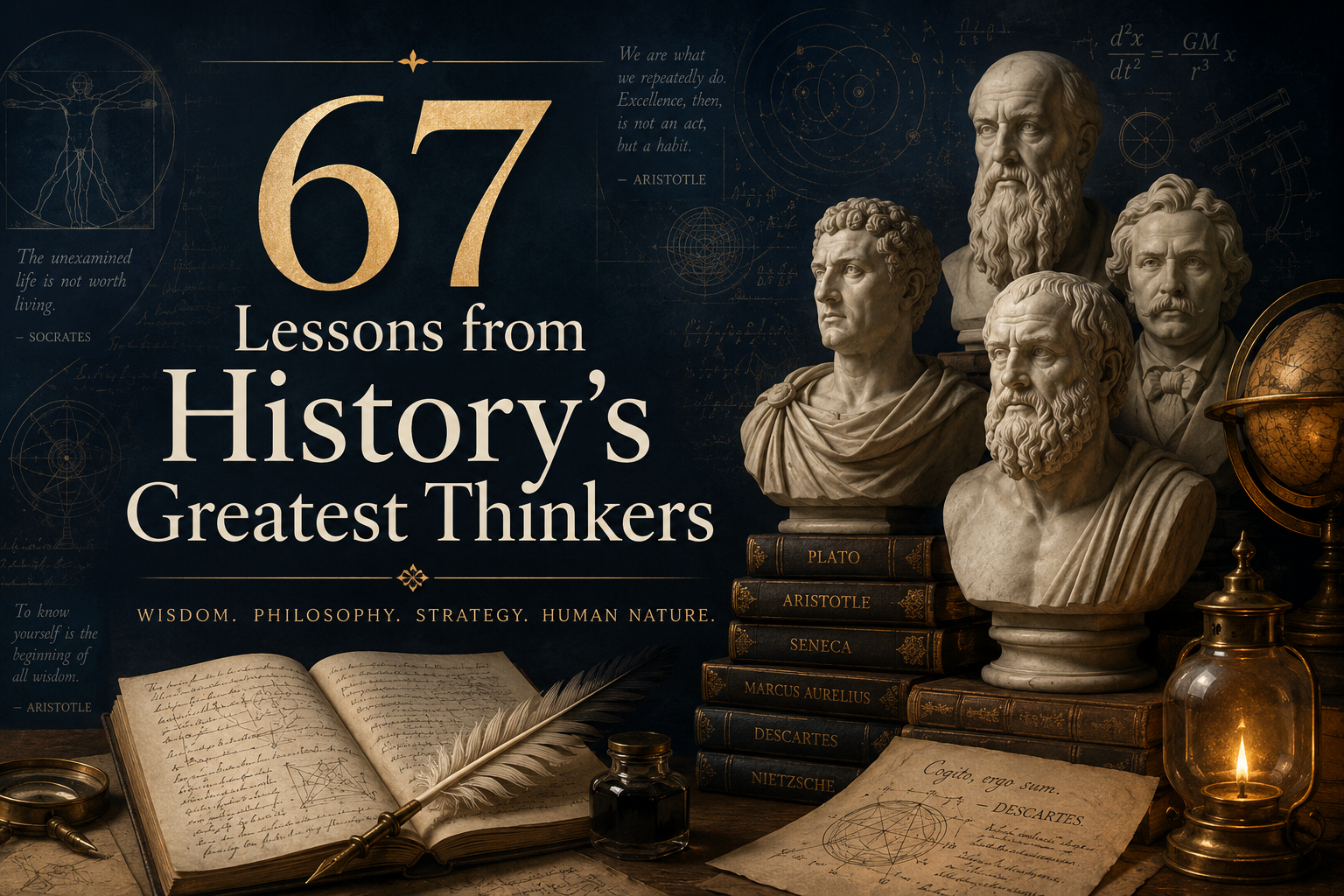
67 Lessons From History’s Greatest Thinkers
Some ideas survive for thousands of years because they describe human nature more accurately than most modern advice ever could.
Long before productivity hacks, social media, personal brands, and self-help gurus, history’s greatest thinkers were wrestling with the same questions we still struggle with today.
How do you control emotion? How do you build discipline? Why do intelligent people sabotage themselves? What creates a meaningful life? And why do some people remain calm, focused, and resilient while others drift through life reacting to everything around them?
This series is not a collection of motivational quotes. It is a practical exploration of timeless ideas — translated into lessons for modern leadership, performance, discipline, resilience, and self-mastery.
Each lesson begins with a thought from one of history’s great minds. But the real value is not the quote itself. It is what the quote reveals about how people think, behave, lead, struggle, and change.
Lesson 1
The Psychological Trap Marcus Aurelius Warned About
“You have power over your mind — not outside events.”
— Marcus Aurelius
Most people spend enormous amounts of energy trying to control things they were never designed to control.
Other people’s opinions. Economic conditions. Social validation. Outcomes. The future. The behaviour of people who were never going to act how you wanted them to act anyway.
The Stoics believed much of human suffering comes from attaching your emotional stability to external events. Modern life amplifies this problem constantly. Social media trains emotional reactivity. News cycles monetise outrage. Algorithms reward anxiety.
Marcus Aurelius understood something most people still struggle to accept: peace comes from controlling your response before trying to control the world.
Calm people are not calm because life is easier for them. They are calm because they have trained the part of themselves that reacts before it thinks.
Lesson 2
The Ancient Principle Most People Ignore
“Until you make the unconscious conscious, it will direct your life and you will call it fate.”
— Carl Jung
One of the most uncomfortable truths about human behaviour is that most people are not nearly as self-aware as they believe.
They think they are making rational decisions. But often, emotion is deciding. Insecurity is deciding. Habit is deciding. Fear is deciding. Ego is deciding.
Then the outcome gets labelled as bad luck, stress, life circumstances, or “just the way things are”.
Jung believed the parts of ourselves we refuse to examine quietly control us from the background. That is why patterns repeat. The same reactions. The same relationships. The same avoidant behaviours. The same self-sabotage.
Awareness creates choice. Choice changes direction.
Most people never stop long enough to examine the patterns running their life.
Lesson 3
Why Calm People Often Outperform Emotional People
“We suffer more in imagination than in reality.”
— Seneca
A remarkable amount of modern stress never actually happens.
People suffer from imagined conversations, future scenarios, worst-case outcomes, hypothetical failures, and social judgement that may never arrive.
Seneca recognised that human beings often create more suffering internally than reality creates externally.
This matters because emotional energy is finite. The people who constantly catastrophise situations burn psychological fuel before real problems even appear.
Calm people are not emotionally numb. They simply waste less energy fighting imaginary battles.
That creates clearer thinking, better decisions, and more resilience under pressure.
Lesson 4
The Sentence That Explains Why Most People Stay Stuck
“He who has a why to live can bear almost any how.”
— Friedrich Nietzsche
Most people believe discipline problems are solved through motivation.
But motivation is unreliable. Meaning is far more powerful.
People can tolerate enormous difficulty when they feel connected to something meaningful: purpose, responsibility, mission, family, growth, contribution, or a future they genuinely care about.
Without meaning, even simple tasks feel heavy. Modern life creates an unusual problem: people often have more comfort than ever before, but less purpose.
Nietzsche understood something many people still miss: a strong why changes human endurance completely.
Lesson 5
The Mental Habit That Quietly Destroys Discipline
“No man is free who is not master of himself.”
— Epictetus
Modern culture often defines freedom as doing whatever you want.
The Stoics saw freedom differently. They believed a person controlled by impulse is not free at all. They are controlled by appetite, emotion, distraction, comfort, and craving.
That idea has never been more relevant.
We live inside environments designed to weaken self-control: endless scrolling, instant gratification, processed food, dopamine-driven apps, constant stimulation.
Every unchecked impulse slightly weakens self-command. Every disciplined action strengthens it.
Self-discipline is not punishment. It is the ability to direct your behaviour intentionally instead of reactively.
Lesson 6
The Ancient Warning About Comfort Most People Miss
“Beware the barrenness of a busy life.”
— Socrates
Modern people are constantly busy.
But busyness and direction are not the same thing.
A person can spend years responding to notifications, attending meetings, chasing productivity, consuming content, and staying occupied while never reflecting deeply on where their life is actually going.
Busyness can become a socially acceptable form of avoidance.
Socrates believed reflection was essential to a meaningful life. Without self-examination, people slowly drift into lives they never consciously chose.
Modern culture rewards noise. But clarity usually emerges from silence.
Lesson 7
Why Intelligent People Still Ruin Their Lives
“People will do anything, no matter how absurd, to avoid facing their own souls.”
— Carl Jung
Intelligence does not automatically create wisdom.
In fact, highly intelligent people are often extremely effective at rationalising destructive behaviour.
They can explain procrastination, emotional reactions, unhealthy relationships, addictions, avoidance, and ego without ever confronting the real issue underneath.
Jung believed human beings spend enormous energy avoiding uncomfortable truths about themselves.
Because self-confrontation is painful.
But avoiding truth creates long-term suffering.
The people who grow most are rarely the people who know the most. They are the people willing to examine themselves honestly.
That level of honesty is rare. Which is exactly why it becomes powerful.