
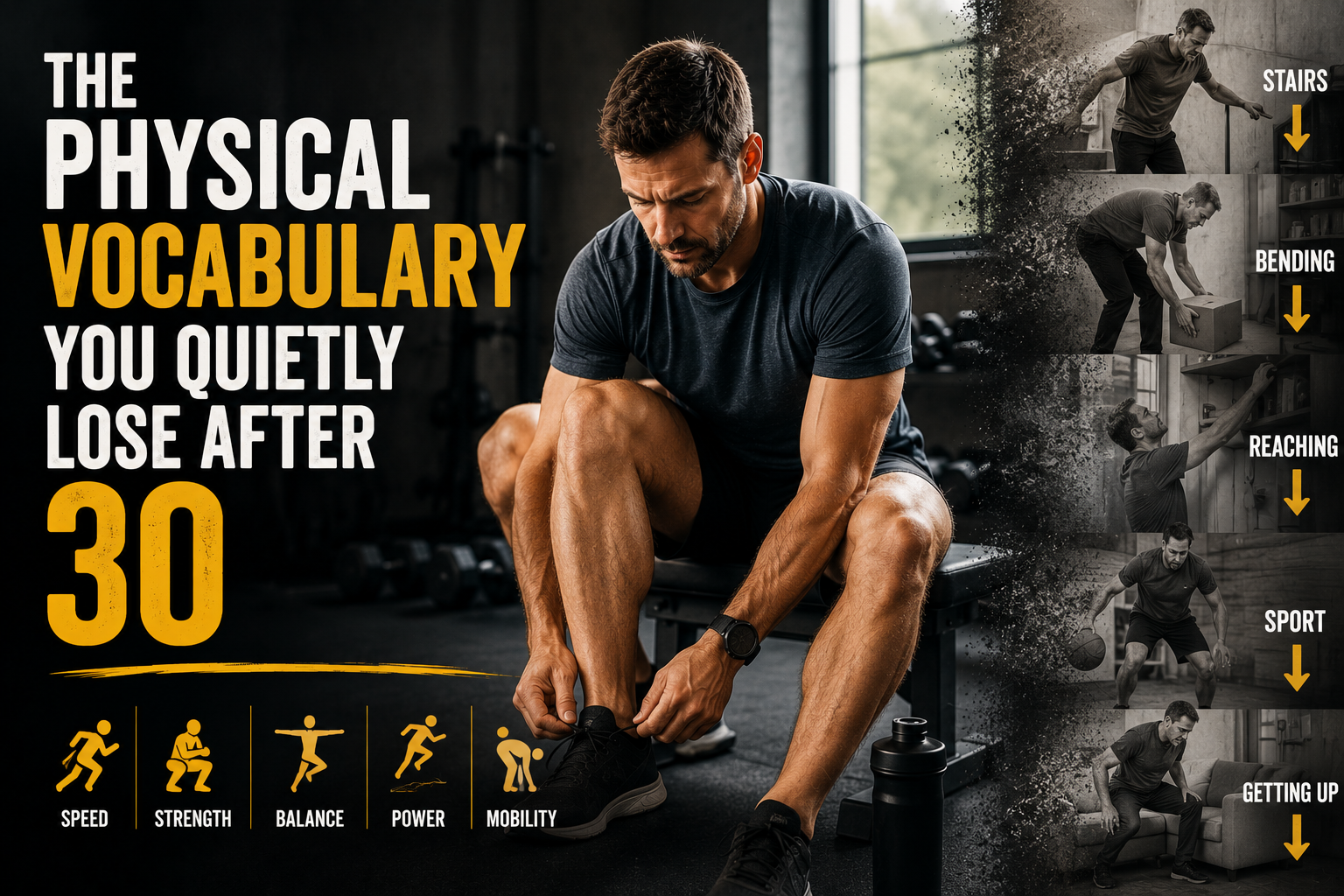
The Physical Vocabulary You Quietly Lose After 30
Most adults think they lose athleticism because they get older. Often, they lose it because they stop practising the movements that once made them physically fluent.
Your Body Doesn't Forget Because You Get Older. It Forgets Because You Stop Speaking The Language.
Imagine you spent your childhood living in Spain.
By the age of twelve you spoke fluent Spanish. You didn't consciously translate every sentence into English before speaking. You didn't pause to remember grammar rules or search for vocabulary. The language simply existed. You thought in it. You lived in it. It became automatic.
Then life changed.
Your family moved back to England. School became English. Your friends spoke English. Your career developed in English. Years turned into decades, and apart from the occasional holiday, Spanish quietly disappeared from your life.
Twenty years later, someone begins speaking to you in Spanish.
Something strange happens.
You recognise many of the words. You understand the general meaning. Somewhere deep inside your brain, the language still exists. But speaking it feels awkward. You hesitate. You search for words that once came effortlessly. Sentences that would have flowed naturally now require conscious thought.
Eventually you smile and say:
I used to be fluent.
Nobody would conclude that your brain suddenly became incapable of learning languages.
Nobody would say that turning forty automatically damages your ability to speak Spanish.
The obvious explanation is much simpler.
You stopped using it.
I think something remarkably similar happens to our bodies.
Most adults believe they become less athletic because they get older. They assume that stiff hips, poor balance and disappearing coordination are simply the unavoidable consequences of ageing.
I'm not convinced.
I think many people are experiencing something entirely different.
They're quietly forgetting a language they once spoke fluently.
Movement Is A Language, Not An Exercise Programme
One of the biggest misconceptions in modern fitness is that movement exists primarily to burn calories.
As a result, people judge activity by asking questions such as:
How many calories did that burn?
Did it elevate my heart rate?
Did it count as cardio?
Those are perfectly reasonable questions if your only objective is body composition.
But the human body evolved long before calorie trackers, treadmills and fitness watches existed.
Movement was never simply about energy expenditure.
Movement was communication.
Every physical challenge told your nervous system something important about the environment it needed to survive.
When you climbed a tree, your body received information:
Climbing is important. Maintain this capability.
When you sprinted after prey or away from danger, it received another message:
Speed matters. Keep investing resources here.
When you carried heavy objects, balanced on uneven ground or crawled through difficult terrain, your body reached the same conclusion:
These abilities appear valuable. Don't lose them.
The body is constantly collecting evidence about what your future life is likely to demand.
It doesn't care about your ambitions. It doesn't care about your New Year's resolutions. It doesn't even care what you intend to do next month.
It responds to evidence.
And evidence is created through repetition.
This explains one of the most important principles in human performance:
Your body doesn't become what you occasionally do. It becomes what you repeatedly practise.
Children Don't Exercise. They Experiment.
Watch children playing in a park for thirty minutes.
Almost nothing they do resembles what adults call exercise.
They're not counting repetitions. They're not monitoring heart rate zones. They're certainly not worrying about whether they're burning enough calories.
Instead, they're solving movement problems.
Every fallen tree becomes something to climb. Every wall becomes something to balance on. Every puddle becomes something to jump over. Every game becomes an opportunity to sprint, stop suddenly, change direction, crawl underneath obstacles or throw objects with surprising force.
To adults, this often looks chaotic.
To the nervous system, it looks like education.
Every one of those experiences teaches the brain something about the physical world.
How do I land safely?
How do I coordinate my arms and legs while climbing?
How do I recover if I lose my balance?
How do I generate enough force to jump across a gap?
Children aren't consciously analysing these questions.
Their brains are simply accumulating solutions.
They're building what I call a Physical Vocabulary.
Just as learning new words allows you to express increasingly complex ideas, learning new movements allows your body to solve increasingly complex physical problems.
The remarkable thing is that young children possess an enormous movement vocabulary without ever thinking about it.
They squat naturally. They crawl effortlessly. They rotate freely. They hang from bars. They jump without hesitation. They fall, recover and try again.
None of this is remarkable to them because it is normal.
It's simply the language they speak every day.
Then Something Quietly Changes
Nobody wakes up one morning and decides to stop moving well.
The change is gradual.
School introduces more sitting. University introduces more studying. Careers introduce more desks. Cars replace walking. Lifts replace stairs. Meetings replace movement. Technology removes thousands of small physical challenges that previous generations encountered every day.
None of these developments are inherently negative.
In many ways they represent enormous progress.
The problem is repetition.
The average professional's day might look something like this:
Wake up. Walk downstairs. Drive to work. Sit for several hours. Walk to a meeting. Sit again. Drive home. Sit for dinner. Sit on the sofa. Go to bed.
The body is extraordinarily adaptable.
So it begins drawing conclusions.
Apparently climbing isn't important anymore.
Apparently sprinting isn't necessary.
Apparently balancing, crawling and hanging have disappeared from our environment.
Maintaining these abilities costs energy.
And evolution has never liked waste.
The body therefore does what efficient organisations always do.
It quietly stops investing resources into departments that no longer appear necessary.
Most people call this ageing.
I think it often has a different name.
It's called forgetting.
Not because your body has become defective.
But because, like any language, it gradually loses fluency when you stop speaking it.
The Specialist Trap
Modern society celebrates specialists.
The best surgeon specialises. The best lawyer specialises. The best software engineer specialises. The best golfer, pianist and Formula One driver all specialise.
We are taught from an early age that success comes from becoming exceptionally good at one thing.
For careers, this is often excellent advice.
For the human body, it can become a hidden problem.
Your body did not evolve to perform one movement repeatedly.
It evolved to solve an almost endless variety of unpredictable physical problems.
For almost all of human history, there was no such thing as a "normal day."
One morning you might climb to collect fruit. The afternoon might involve carrying heavy objects. The following day you might walk twenty miles. The next day you might sprint, crawl, throw, balance or lift awkward loads from the ground.
The body that survived was not the body that excelled at one movement.
It was the body that remained competent across many.
It was a generalist.
Modern life has quietly reversed this.
The average office worker performs thousands of repetitions of exactly the same movements every week.
Sit. Stand. Walk a short distance. Drive. Type. Sit again.
From the body's perspective, this is simply data.
It concludes:
Apparently these are the only movements our future depends upon.
So it optimises accordingly.
Your hips become increasingly adapted to prolonged sitting. Your ankles become less mobile because they are rarely challenged. Your shoulders spend years positioned in front of your body rather than overhead. Your balance is rarely tested. Your ability to accelerate and decelerate is almost never required.
The body isn't making a mistake.
It is doing exactly what evolution designed it to do.
It is becoming better at the life you repeatedly live.
The problem is that life occasionally asks completely different questions.
Can you climb onto that wall? Can you react if you slip? Can you pick your grandchild up from the floor? Can you carry two heavy suitcases through an airport? Can you hike for six hours on holiday?
These are not specialist tasks.
They are general human tasks.
Ironically, many highly successful professionals have become specialists in one physical skill:
Remaining seated.
And because this adaptation happens over years rather than weeks, they interpret the gradual loss of capability as ageing rather than specialisation.
I think that distinction matters enormously.
Because if something has been lost through lack of use, it can often be rebuilt through renewed use.
Your Brain Stores Solutions, Not Muscles
When most people think about strength training, they imagine muscles.
Bigger muscles.
Stronger muscles.
More defined muscles.
But your nervous system thinks very differently.
Your brain does not organise movement by muscle groups.
It organises movement by problems.
Imagine standing up from a chair.
You don't consciously think:
Contract quadriceps by 30%. Activate gluteus maximus. Stabilise through the hamstrings.
You simply think:
Stand up.
Your brain solves the problem automatically.
The muscles are merely tools.
This explains one of the strangest observations in strength training.
Beginners often become dramatically stronger within weeks despite gaining very little muscle.
Why?
Because the hardware has barely changed.
The software has.
The nervous system has simply become more efficient at solving the movement problem.
Think about learning to drive.
Initially every action demands attention.
Mirror.
Signal.
Clutch.
Gear.
Steering.
You consciously think about everything.
After years of practice, you drive home while barely remembering the journey.
You haven't become physically stronger.
You've automated the solution.
Movement works in exactly the same way.
Every repetition teaches your nervous system a slightly better solution.
Every good repetition strengthens that solution.
Every poor repetition also strengthens a solution.
Your body doesn't distinguish between good habits and bad habits.
It simply repeats what you repeatedly teach it.
That's why technique matters.
You're not just performing today's movement.
You're programming tomorrow's automatic behaviour.
Why The Body Deletes Unused Skills
Many people imagine the body as a machine that wants maximum capability.
It doesn't.
It wants maximum efficiency.
Maintaining muscle tissue is expensive. Maintaining explosive power is expensive. Maintaining coordination, mobility and balance all require resources.
Evolution has never rewarded unnecessary expenditure.
Imagine you run a successful business.
Your accounts department notices that one division hasn't produced any value for ten years.
It still consumes salaries, office space, technology and management time.
Eventually somebody asks:
Do we actually need this department anymore?
If the answer is no, investment is reduced.
The body performs a remarkably similar audit.
Never sprint?
Apparently sprinting isn't essential.
Never climb?
Apparently climbing no longer matters.
Never rotate?
Apparently rotational power has little value.
Never lift anything heavy?
Apparently strength is an unnecessary expense.
So investment quietly falls.
This is not punishment.
It is optimisation.
The body is trying to become a more efficient version of the person you repeatedly demonstrate yourself to be.
The tragedy is that your environment may have become artificially easy while your future life remains physically unpredictable.
The body cannot know that.
It simply follows the evidence.
And evidence comes from repetition.
Confidence Is Stored Experience
People spend enormous amounts of time trying to become more confident.
They read books.
Attend seminars.
Listen to motivational speeches.
Yet confidence often emerges from a much simpler source:
Experience.
Imagine two people standing beneath a climbing wall.
One climbed trees every weekend as a child and still hikes regularly.
The other hasn't climbed anything in thirty years.
Which person feels more confident?
Usually the first.
Not because they possess a stronger mindset.
Because their nervous system has solved this problem before.
The brain constantly estimates risk by asking one simple question:
Have we successfully done something like this before?
If the answer is yes, confidence appears.
If the answer is no, caution appears.
Confidence is therefore less a personality trait than accumulated evidence.
Every successful movement becomes proof.
Proof becomes expectation.
Expectation becomes confidence.
This is one reason maintaining a broad Physical Vocabulary matters so much.
You're not merely preserving movement.
You're preserving certainty.
You're teaching your brain that your body remains capable of solving unfamiliar problems.
That confidence extends far beyond the gym.
It changes how you approach life itself.
The Hidden Cost Of A Shrinking Vocabulary
The greatest danger is that capability rarely disappears dramatically.
It disappears quietly.
You stop joining games because you "don't really run anymore."
You choose the lift because the stairs seem inconvenient.
You avoid scrambling over rocks on holiday.
You let somebody else carry the heavy suitcase.
You hesitate before kneeling on the floor because getting back up might be uncomfortable.
Individually these decisions seem insignificant.
Collectively they change your life.
Your world becomes slightly smaller each year.
Eventually many people conclude that ageing has taken opportunities away from them.
I think something else often happened.
Their Physical Vocabulary became so limited that they stopped saying yes.
The real purpose of training, therefore, is not simply to build strength or muscle.
It is to preserve options.
Every movement you continue to practise keeps another word alive in your body's dictionary.
And one day, when life unexpectedly asks a physical question, you'll only be able to answer using the movements your body still remembers how to speak.