
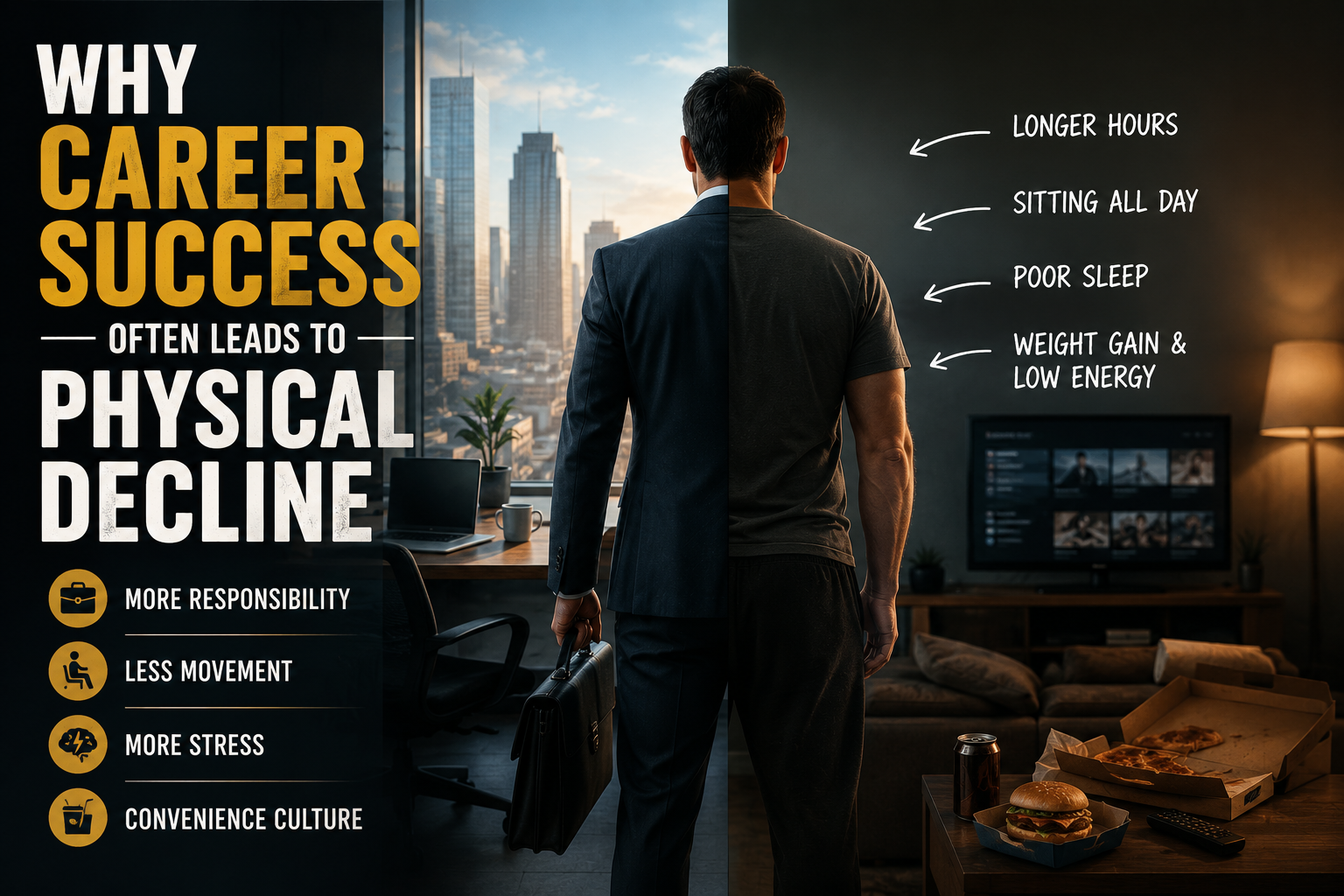
Why Career Success Often Leads to Physical Decline
The promotion, pay rise, and career progression you worked so hard for may be quietly making you weaker, heavier, and more exhausted. Here’s why success often comes with hidden physical costs — and how to avoid paying them.
Most people assume physical decline is caused by age, laziness, or a lack of discipline.
The story is familiar. Someone was relatively lean and active in their twenties. As the years passed, they exercised less, gained weight, lost fitness, and gradually let themselves go.
There is some truth to that explanation.
However, I believe it misses a far more useful reality.
Many intelligent, ambitious, and disciplined people experience physical decline not despite becoming successful, but because they become successful.
That statement sounds counterintuitive at first.
After all, success should create more options. More freedom. More control.
Yet if you look around many offices, boardrooms, and professional environments, you will notice something peculiar.
As careers advance, physical capability often declines.
The promotion arrives. The income increases. The responsibility expands.
Yet energy levels fall. Body fat increases. Strength decreases. Athleticism disappears.
The question is why.
I believe the answer lies in what I call the Four Taxes of Success.
Just as financial success often comes with higher tax obligations, professional success frequently imposes four hidden taxes on physical health and performance.
Individually, they seem harmless.
Collectively, they can dramatically reshape your body over a decade.

The Four Taxes of Success
Most adults do not suddenly become overweight or unfit.
The process is gradual.
A little less movement. A little less recovery. A little more stress. A little more convenience.
Over time, these changes compound.
The Four Taxes of Success provide a useful framework for understanding why professional progress can quietly create physical decline.
Tax #1: The Time Tax
Success almost always demands more of your time.
More meetings. More projects. More clients. More travel. More responsibility.
Professionally, this is often viewed as progress.
Physically, however, it creates a problem.
Time is a finite resource. Every new responsibility competes with something else.
For many adults, training becomes one of the first things sacrificed. Not because it is unimportant, but because it is flexible.
Nobody notices if you skip a workout. Nobody notices if you go to bed later. Nobody notices if you order takeaway instead of cooking.
The danger is that these small compromises accumulate.
Many people spend years telling themselves they will prioritise fitness again once life settles down.
The problem is that life rarely settles down.
Tax #2: The Movement Tax
This may be the most overlooked consequence of professional success.
The more valuable many people become professionally, the less they move physically.
Early career roles often involve more movement, more commuting, more travelling between locations, and more incidental physical activity.
As careers advance, work increasingly revolves around screens, meetings, calls, and decision-making.
A warehouse operative may walk 15,000 steps per day without thinking about it.
A senior manager may struggle to accumulate 4,000.
Neither person necessarily notices the difference immediately.
Yet over years, the impact is enormous.
Many people focus entirely on gym sessions while ignoring daily movement. In reality, total activity often matters far more than a handful of weekly workouts.
A reduction of several thousand daily steps, sustained for years, creates a substantial shift in energy expenditure.
Not enough to notice this week.
More than enough to notice this decade.
Tax #3: The Stress Tax
Professional success often brings psychological demands that previous generations rarely experienced at the same scale.
Targets. Deadlines. Financial pressure. Responsibility for teams. Constant connectivity. Decision fatigue.
Many people assume stress only affects mental wellbeing.
In reality, it influences almost every behaviour related to body composition and performance.
Stress affects sleep quality. Sleep affects recovery. Recovery affects training performance.
Stress influences appetite. Appetite influences food choices. Food choices influence body composition.
The entire system is connected.
This is why many adults know exactly what they should be doing but struggle to execute consistently during demanding periods.
The issue is rarely knowledge.
The issue is that chronic stress pushes people towards short-term comfort and away from long-term health.
Tax #4: The Convenience Tax
Success often increases access to convenience.
More disposable income. More restaurant meals. More food delivery. More travel. More opportunities to outsource effort.
On the surface, this sounds positive.
In many ways it is.
However, convenience has a hidden downside.
Modern environments make consuming calories remarkably easy while making movement increasingly optional.
You can order a thousand calories with a few taps on a phone.
You can spend an entire day sitting without ever needing to leave your chair.
The problem is not convenience itself.
The problem is that convenience systematically removes physical effort from daily life.
Over time, this creates a lifestyle that becomes increasingly comfortable and increasingly unhealthy.
Why Most Fitness Advice Fails Professionals
Understanding the Four Taxes of Success also explains why many fitness programmes fail.
Most fitness advice is created by people whose primary hobby is fitness.
The programmes assume unlimited motivation, predictable schedules, abundant recovery, and flexible lifestyles.
Most working adults do not live in that reality.
The average professional does not need a more sophisticated programme.
They need a more realistic one.
The challenge is not finding the perfect training split.
The challenge is finding a system that survives busy periods at work, travel, family commitments, stressful seasons, and low motivation.
A mediocre plan executed consistently will outperform a perfect plan abandoned after three weeks.
The Real Goal Is Not Fat Loss
This is another area where many people focus on the wrong metric.
The goal is not simply losing weight.
The goal is preserving capability.
Many adults spend years simultaneously losing muscle, gaining fat, reducing movement, and increasing stress.
The scale often changes very little.
Yet physical capability declines dramatically.
Strength decreases. Athleticism fades. Energy falls. Confidence suffers.
This is why body composition matters more than body weight.
Two people can weigh exactly the same while possessing completely different levels of physical capability.
The objective should be maintaining strength, muscle, and performance while controlling body fat.
Not simply becoming lighter.
How To Beat The Four Taxes of Success
The solution is not extreme discipline.
Nor is it an elaborate optimisation strategy.
The solution is building systems that directly counter the four taxes.
The aim is not to make fitness your entire identity. The aim is to protect the minimum behaviours that allow you to remain strong, lean, energetic, and capable while continuing to build a demanding career.
Counter the Time Tax
The mistake many adults make is waiting until they have more time.
That almost never happens.
The people who remain fit throughout demanding careers do not find extra time. They allocate it intentionally.
Think about how you treat important meetings. You do not ask yourself each morning whether you feel motivated to attend. You attend because it is already committed.
Training should be treated similarly.
The key is to establish a minimum standard rather than an ideal standard.
Many adults fail because their plan requires five or six weekly training sessions. When work becomes demanding, the entire system collapses.
A better approach is to decide the minimum effective dose you can maintain even during busy periods.
For most adults, this might mean three strength sessions per week, regular walking, and a basic nutrition structure.
The point is not perfection.
The point is continuity.
A consistent three-day plan repeated for years will outperform an ambitious six-day plan that collapses every time life becomes demanding.
Counter the Movement Tax
One of the biggest misconceptions in fitness is that exercise and movement are the same thing.
They are not.
A person can complete a one-hour gym session and still spend the remaining 23 hours of the day largely sedentary.
Researchers often refer to non-exercise movement as NEAT, or Non-Exercise Activity Thermogenesis.
This includes walking, standing, taking the stairs, doing household tasks, moving between locations, and general activity throughout the day.
For many adults, declining NEAT explains far more weight gain than a lack of formal exercise.
Consider two people who both attend the gym three times per week.
One accumulates 12,000 steps per day.
The other accumulates 4,000.
Their gym routines may look similar, but their weekly energy expenditure is not remotely the same.
This is why protecting daily movement may be one of the highest-return habits available for body composition and long-term health.
Practical strategies include walking meetings, lunch-time walks, parking further away, standing while taking calls, using stairs where possible, and setting a realistic daily step target.
The goal is not simply burning calories.
The goal is preserving a physically active lifestyle in a world that increasingly removes movement by default.
Counter the Stress Tax
Many people attempt to solve stress-related fitness problems through discipline.
Unfortunately, stress often undermines the very behaviours discipline depends upon.
When stress increases, sleep quality often deteriorates. Hunger can increase. Cravings become stronger. Recovery slows. Motivation decreases.
This creates a vicious cycle.
Poor recovery leads to poorer decisions. Poorer decisions lead to worse body composition. Worse body composition often creates further frustration and stress.
The solution is not simply trying harder.
The solution is reducing recovery debt.
This means protecting sleep, managing workload where possible, building decompression routines, and adjusting training expectations during high-stress periods.
Many adults would make better progress by improving sleep than by changing their workout plan.
Recovery is not laziness.
Recovery is the condition that allows training, nutrition, and discipline to work.
Counter the Convenience Tax
The answer to convenience is not eliminating convenience.
That is unrealistic for most working adults.
The smarter approach is designing convenience in your favour.
If healthy choices require effort and unhealthy choices are effortless, the environment will eventually win.
This is why nutrition should be systemised.
Keep high-protein foods easily available. Create repeatable breakfast and lunch options. Use simple shopping lists. Prepare reliable meals that require minimal thought. Remove highly tempting foods from immediate environments where possible.
The goal is not relying on willpower every evening after a demanding day.
The goal is making the better choice the easier choice.
Convenience becomes dangerous when it only serves comfort.
It becomes powerful when it serves your standards.
Final Thoughts
The biggest misconception about physical decline is that it is an inevitable consequence of ageing.
In reality, many of the changes people attribute to age are actually the cumulative effects of the Four Taxes of Success.
More demands on your time.
Less movement.
Higher stress.
Greater convenience.
Left unmanaged, these forces gradually erode physical capability.
Not over weeks.
Over years.
The encouraging reality is that awareness changes everything.
Once you recognise the hidden costs of success, you can begin building systems that protect your health while continuing to progress professionally.
Career success and physical capability do not have to exist in opposition to one another.
However, maintaining both requires understanding that success creates pressures which must be actively managed.
The people who remain strong, lean, and capable into their forties, fifties, and beyond are not necessarily more disciplined than everyone else.
They have simply learned how to pay fewer of the hidden taxes.