
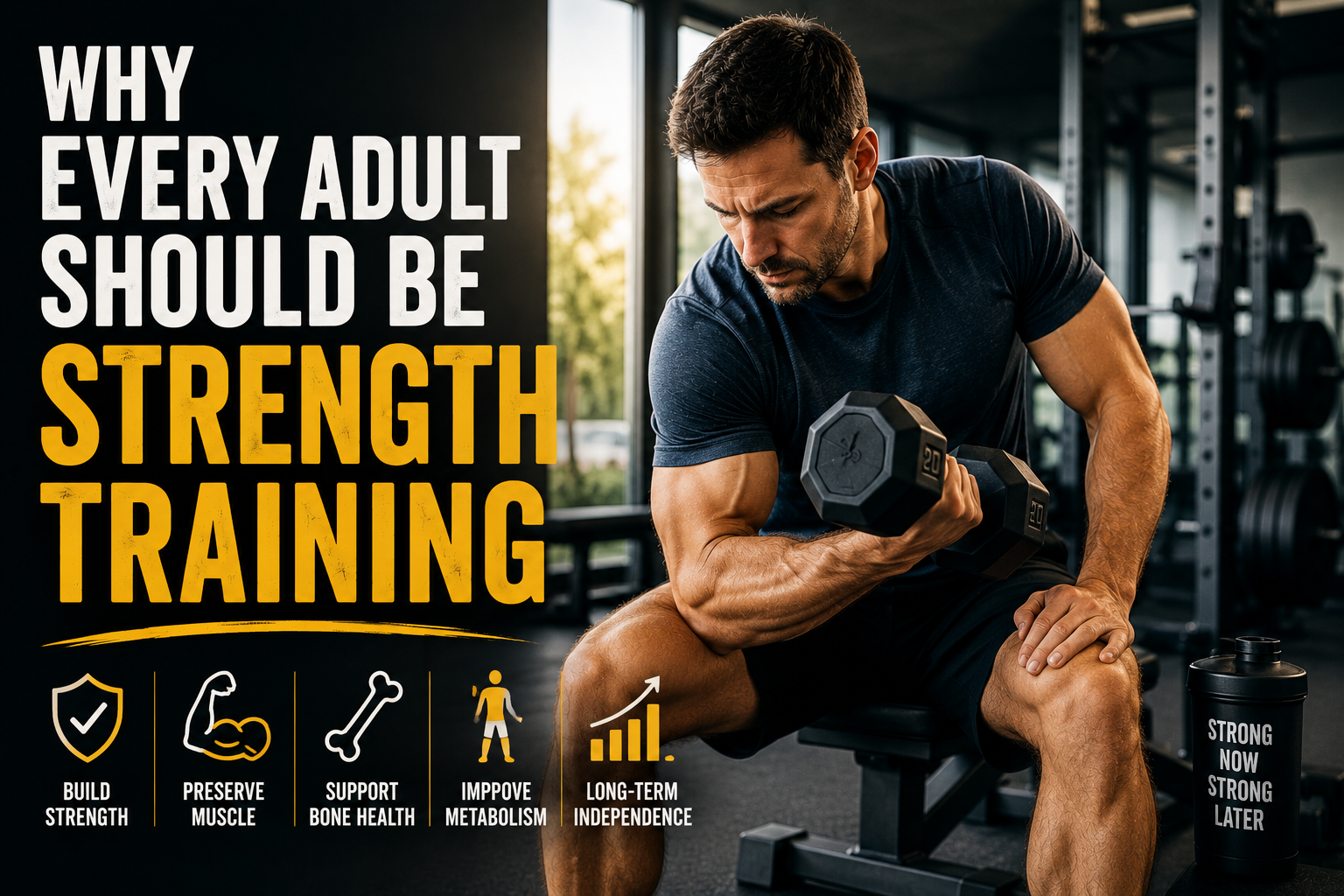
Why Every Adult Should Be Strength Training
Strength training is not just about building muscle. It is about protecting your Physical Balance Sheet, preserving future freedom, and giving your older self more options.
You're Not Building Muscle. You're Building Future Freedom.
Imagine sitting down with a financial adviser.
They ask a series of perfectly sensible questions.
Do you contribute to your pension?
Do you have emergency savings?
Are you investing regularly?
Do you own assets that will appreciate over time?
Most intelligent adults understand exactly why these questions matter.
Money invested today compounds into opportunity tomorrow.
Small, consistent contributions become substantial over decades.
Waiting twenty years makes the same outcome dramatically more difficult.
Very few people would argue with that logic.
Now imagine the adviser asks one final question.
What are you doing to protect your Physical Balance Sheet?
Most people wouldn't even know what that means.
Yet I would argue it is one of the most important financial questions you'll ever answer.
Because while money determines what you can afford, your body determines what you're capable of doing with it.
You can own a beautiful house.
But can you climb the stairs?
You can afford a skiing holiday.
But can your knees tolerate it?
You can fly business class around the world.
But can you comfortably carry your luggage through the airport?
You can retire at fifty-five.
But can you actually enjoy the next thirty years?
We spend decades obsessing over financial assets while quietly allowing our physical assets to depreciate.
I think we've been measuring wealth incorrectly.
The Two Balance Sheets
Every adult manages two balance sheets.
The first is obvious.
Your financial balance sheet.
Assets.
Liabilities.
Income.
Debt.
Net worth.
Every decision either strengthens or weakens that position.
The second balance sheet is less obvious.
But it is just as real.
Your physical balance sheet.
Every day you make deposits.
Every day you make withdrawals.
Strength training?
Deposit.
Walking?
Deposit.
Good sleep?
Deposit.
Nutritious food?
Deposit.
Chronic stress?
Withdrawal.
Poor sleep?
Withdrawal.
Years spent sitting?
Withdrawal.
Ignoring movement?
Withdrawal.
The fascinating thing is that your body keeps these accounts whether you acknowledge them or not.
Unlike money, you cannot choose not to participate.
You are investing every single day.
The only question is whether you're investing wisely.
The Physical Investment Portfolio
Every investor understands diversification.
You wouldn't put your entire retirement into a single speculative stock.
You build a portfolio.
Your body works remarkably similarly.
I call this your Physical Investment Portfolio.
It consists of assets that quietly compound throughout your life.
Muscle
Most people think muscle exists for appearance.
It doesn't.
Muscle is reserve capacity.
It's what allows carrying shopping bags to feel easy.
It's what lets you move furniture without injury.
It's what helps you recover from illness more effectively.
It's the savings account of physical capability.
Bone
You rarely think about bone density until something goes wrong.
Bones respond to loading.
They strengthen when challenged.
Like many investments, the benefits are invisible for years.
But one day they become priceless.
Movement
Movement is a skill.
Every repetition teaches your nervous system what normal looks like.
Good movement compounds.
Poor movement compounds too.
Your body is always learning.
The question is whether you're teaching it well.
Confidence
Confidence is often treated as purely psychological.
I don't think it is.
Strong people approach physical problems differently.
They volunteer to carry things.
They move without hesitation.
They trust their body.
Repeated evidence creates confidence.
Confidence becomes behaviour.
Behaviour becomes identity.
Independence
Perhaps the greatest asset of all.
Can you get off the floor?
Can you climb a hill?
Can you lift your grandchild?
Can you carry luggage?
Can you remain self-sufficient?
Ultimately, this is what strength training is purchasing.
Not bigger muscles.
Greater freedom.
Society Has Quietly Outsourced Physical Capability
For most of human history, movement wasn't optional.
You carried water.
You chopped wood.
You walked.
You climbed.
You lifted.
Your environment forced you to maintain capability.
Modern life has been extraordinarily successful at removing physical inconvenience.
Shopping arrives at your door.
Lifts replace stairs.
Cars replace walking.
Robot vacuum cleaners replace sweeping.
Office chairs replace manual labour.
Technology has solved thousands of physical problems.
Unfortunately, your body evolved expecting those problems to exist.
Your physiology follows an extraordinarily simple rule:
It only maintains what it believes it needs.
If you never lift heavy objects, why preserve strength?
If you never sprint, why preserve power?
If you never climb, why preserve climbing ability?
Your body is remarkably efficient.
It quietly removes expensive capabilities that you no longer demonstrate a need for.
Many people call this ageing.
Quite often, it's simply adaptation.
The Biggest Mistake Adults Make
Perhaps the most dangerous sentence in fitness is:
I'll get back into shape when life settles down.
Life rarely settles down.
Careers become more demanding.
Families become larger.
Responsibilities multiply.
Stress accumulates.
Ironically, the exact period when strength becomes most valuable is often the period when people stop building it.
Imagine telling your financial adviser:
I'm going to stop contributing to my pension during my highest earning years. I'll start again later.
The advice would sound ridiculous.
Yet millions of adults make precisely that decision with their bodies.
They assume physical capability can simply be rebuilt whenever convenient.
Sometimes it can.
But time is the greatest force multiplier any investment possesses.
Whether you're talking about compound interest or physical capability.
And once lost, both become increasingly expensive to rebuild.
The Opportunity Cost Nobody Calculates
Business leaders understand opportunity cost.
Every pound invested in one project cannot be invested somewhere else.
Every hour spent in one meeting cannot be spent on another priority.
Every decision carries hidden consequences.
Oddly, very few people apply this thinking to fitness.
They ask:
Can I afford an hour in the gym?
I think the better question is:
Can I afford decades without it?
An hour of strength training is not simply an hour spent lifting weights.
It is potentially an investment in:
- better energy,
- greater confidence,
- improved resilience,
- reduced injury risk,
- higher work capacity,
- greater independence,
- and a more enjoyable retirement.
The return on investment is extraordinary.
The opportunity cost of doing nothing is rarely visible today.
It becomes visible twenty years later.
The Compound Interest of Strength
People often ask how long it takes to become strong.
I think they're asking the wrong question.
Compound interest doesn't become impressive because of one deposit.
It becomes impressive because of thousands.
Strength works exactly the same way.
Imagine two twenty-five-year-olds.
Both are healthy.
Both have similar genetics.
One strength trains three times per week.
The other intends to start "when life settles down."
After one month, there is almost no difference.
After one year, there is some difference.
After ten years, the gap is substantial.
After thirty years, they may appear to have lived completely different lives.
The remarkable thing is that neither outcome was caused by one decision.
It was caused by thousands of tiny deposits — or thousands of missed deposits.
Most people dramatically overestimate what one workout can achieve.
They dramatically underestimate what one thousand workouts can achieve.
The same is true in reverse.
One missed session is irrelevant.
Ten thousand missed opportunities create a different future.
Compounding is patient.
Eventually, it becomes undeniable.
Your Body Doesn't Understand Intentions
One of the most comforting lies adults tell themselves is:
I know I should exercise.
Your body doesn't care what you know.
It only responds to what you repeatedly do.
Imagine telling your pension provider:
I fully intend to contribute more next year.
Would they add money to your account?
Of course not.
Intentions are not deposits.
The body works the same way.
Your muscles cannot distinguish between good intentions and no intentions.
Your bones cannot strengthen because you planned to train.
Your cardiovascular system cannot adapt because you bought new trainers.
Your body understands one language:
Repeated exposure.
Every repetition is evidence.
Every session is information.
Every week tells your body what capabilities it should preserve.
Strength Is Insurance
Most people think strength training creates capability.
I think it protects capability.
You don't insure your home because it is already burning down.
You insure it because life is unpredictable.
The same principle applies to your body.
You don't know when you'll need to:
- carry someone,
- move furniture,
- recover from illness,
- catch yourself after slipping,
- help a friend,
- lift a child,
- walk ten miles on holiday,
- or get off the floor after a fall.
Life repeatedly asks physical questions.
Strength training doesn't eliminate those questions.
It simply gives you better answers.
Two Different Retirements
Imagine two sixty-five-year-olds.
The first spent forty years building financial wealth.
They have a beautiful house.
An excellent pension.
Luxury holidays.
But they struggle with stairs.
Their back hurts.
Their knees hurt.
They avoid long walks.
Their grandchildren want to play.
They would rather sit.
The second accumulated less financial wealth.
But they invested consistently in their Physical Balance Sheet.
They are strong.
Mobile.
Energetic.
They travel.
They hike.
They carry luggage without thinking.
They play football in the garden with grandchildren.
They volunteer to help friends move house.
They say "yes" to experiences.
Which person is wealthier?
We usually answer that question with a bank statement.
I think the answer should include a body.
You're Not Training For Today
One of the biggest misunderstandings in fitness is that today's workout is about today.
It isn't.
Today's workout is for ten years from now.
You're training for the day you need to climb several flights of stairs with a suitcase.
You're training for the skiing holiday you haven't booked yet.
You're training for the unexpected fall that requires you to catch yourself.
You're training for the grandchild who wants to be picked up.
You're training for the retirement that allows you to travel rather than simply recover.
The workout finishes in an hour.
The adaptation may last decades.
A Different Definition of Wealth
Perhaps we've been measuring success incorrectly.
We celebrate financial net worth.
Yet physical capability determines whether that wealth can be enjoyed.
Money can buy a bicycle.
It cannot guarantee the ability to ride it.
Money can buy a mountain lodge.
It cannot guarantee the ability to climb the mountain.
Money can buy business-class flights around the world.
It cannot guarantee the ability to walk around the destination.
Financial wealth creates options.
Physical capability allows you to take them.
The two should never be viewed separately.
Final Thoughts
Most people think strength training is about building muscle.
I think it's about building options.
Every workout is a deposit.
Every walk is a deposit.
Every night of good sleep is a deposit.
Every year of consistency compounds upon the last.
One day your younger self will leave you two inheritances.
A financial inheritance.
And a physical inheritance.
The financial inheritance determines what you can afford.
The physical inheritance determines what you can actually do.
Most adults spend decades protecting the first while quietly neglecting the second.
I think that's backwards.
Because one day your future self will begin living on the body you've been investing in today.
And when that day arrives, they will ask only one question:
Did you leave me with assets — or liabilities?