
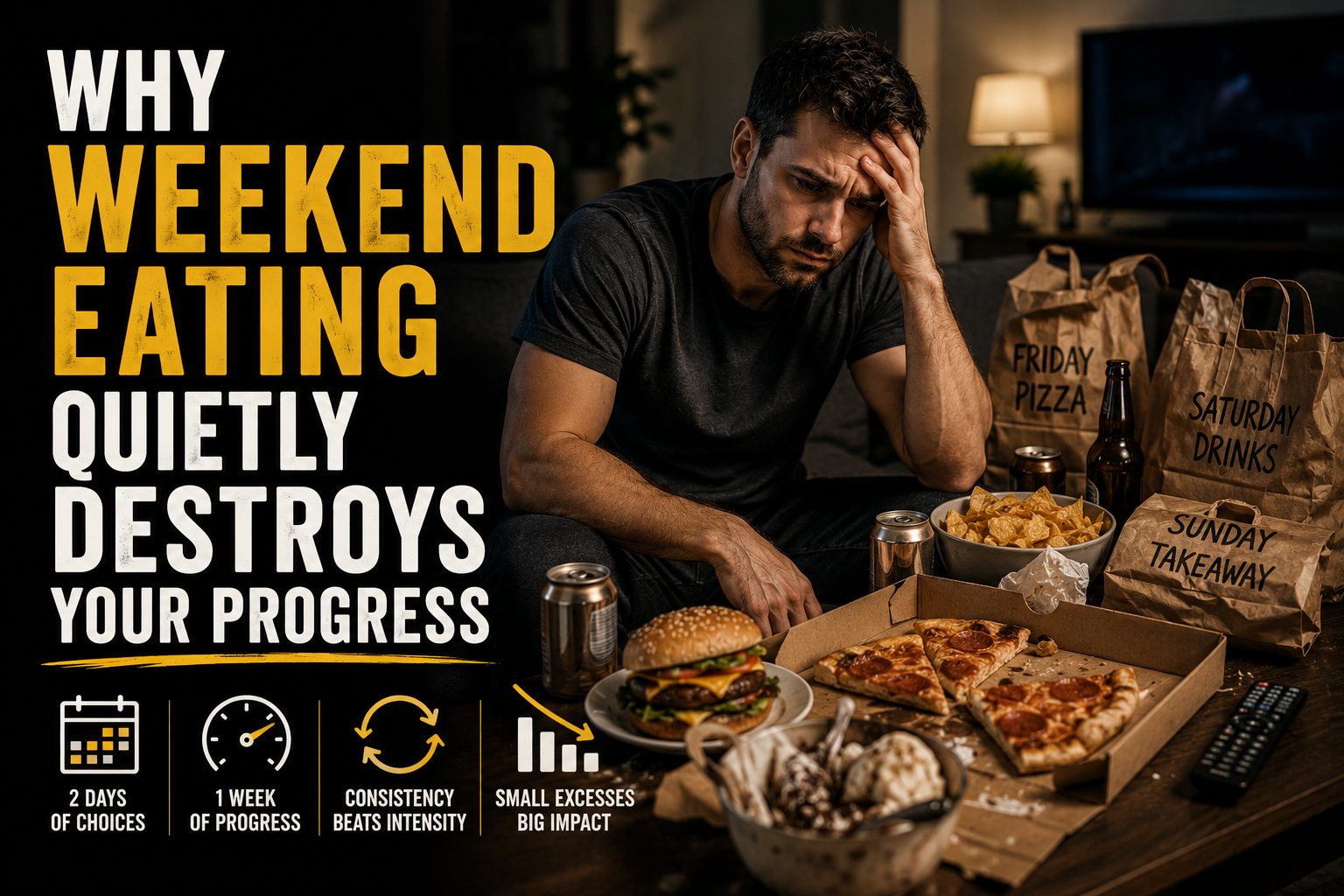
Why Weekend Eating Quietly Destroys Your Progress
Most people think their fat-loss problem is discipline. In reality, many are losing progress at predictable points in the calendar. You do not have a calorie problem. You have a calendar problem.
You Don't Have a Calorie Problem. You Have a Calendar Problem.
Most people believe body fat is determined by thousands of food decisions.
Whether they have toast or eggs for breakfast.
Whether they order chips or a salad.
Whether they have dessert.
Whether they snack in the afternoon.
Whether they finish the biscuits left in the office kitchen.
Their entire approach to nutrition becomes a constant exercise in decision-making.
Every meal is another test.
Every social event is another challenge.
Every day is another opportunity to either succeed or fail.
When they eventually become frustrated, the conclusion seems obvious.
I just need more discipline.
I don't believe that's true.
In fact, I think it is one of the biggest misconceptions in modern nutrition.
Your physique is not determined by thousands of equally important decisions.
It is determined by a surprisingly small number of high-leverage decisions that occur repeatedly throughout your life.
The remarkable thing is that you probably already know exactly what they are.
Friday drinks.
Business travel.
Airport lounges.
Client dinners.
Family celebrations.
Holidays.
Late meetings.
Sunday boredom.
These are not random events.
They appear in your calendar every single week or every single month.
Yet every time they arrive, millions of people approach them as though they are seeing them for the first time.
They hope that this Friday they will somehow make better decisions than they made last Friday.
Hope, unfortunately, is not a strategy.
Which leads me to what I believe is one of the most important ideas in sustainable fat loss.
You probably don't have a calorie problem.
You have a calendar problem.
Your Body Doesn't Know It's Saturday
One of the strangest assumptions people make about dieting is that their body somehow understands context.
It doesn't.
Your body has absolutely no idea that today is Saturday.
It doesn't know you've been "good all week."
It doesn't know you're celebrating a promotion.
It doesn't know it's Christmas.
It doesn't know you're on holiday.
It certainly doesn't know that you've "earned a treat."
Your physiology understands only one language:
Energy.
Calories enter.
Calories leave.
The books are balanced.
That's it.
Your psychology works completely differently.
You judge yourself one day at a time.
Monday: excellent.
Tuesday: excellent.
Wednesday: excellent.
Thursday: excellent.
Friday: not ideal.
Saturday: could have been better.
Sunday: I'll start again tomorrow.
By Monday morning you genuinely believe you had five successful days and two disappointing ones.
Your body remembers something entirely different.
It remembers one week.
This distinction sounds trivial.
I think it explains why so many intelligent people remain stuck for years.

The Weekly Energy Ledger
Imagine trying to save money.
Every weekday you put £100 into a savings account.
Monday.
Tuesday.
Wednesday.
Thursday.
Friday.
By Friday evening you've accumulated £500.
You feel responsible.
You feel disciplined.
You might even tell your partner that you're finally getting on top of your finances.
Then Saturday arrives.
You spend £600.
Would anyone describe you as financially successful that week?
Of course not.
Your weekend dictated the outcome.
Now replace pounds with calories.
The principle is identical.
Your body doesn't congratulate you for eating grilled chicken on Tuesday.
It doesn't award bonus points because your Wednesday lunch contained vegetables.
Nor does it ignore Saturday simply because you were celebrating.
It simply keeps the ledger.
This is where psychology and physiology begin working against one another.
Psychology remembers effort.
Physiology remembers totals.
The Calendar Illusion
Here's a thought experiment.
Imagine two people.
Person A eats 2,400 calories every day.
Nothing exciting happens.
Their week looks almost identical from Monday to Sunday.
Person B approaches nutrition differently.
They eat 1,900 calories Monday to Friday.
They feel hungry.
They avoid social events.
They prepare meals.
By Friday evening they feel proud of their discipline.
Then the weekend arrives.
Drinks.
Brunch.
Restaurant dinner.
Dessert.
A takeaway while watching a film.
Nothing outrageous.
Nothing they would describe as a binge.
By Monday morning Person B feels like someone who dieted incredibly hard all week before "letting themselves enjoy life."
Person A feels like they simply ate normally.
Psychologically, Person B believes they worked much harder.
Physiologically, their weekly energy balance may be remarkably similar.
That's fascinating.
One person remembers sacrifice.
The other remembers consistency.
The body remembers arithmetic.
The Problem Isn't Weekends
Most articles about weekend eating stop here.
They tell you to order healthier meals.
Drink less alcohol.
Avoid dessert.
While these suggestions are sensible, I think they completely miss the point.
The problem isn't weekends.
The problem is predictable failure.
Think about your own life.
Where are you most likely to struggle?
Probably not at 8:30 on a Tuesday morning.
You're unlikely to lose control while eating porridge before work.
You're much more likely to struggle when:
- you've worked sixty hours that week,
- everyone else is drinking,
- the restaurant smells incredible,
- you're tired,
- you're hungry,
- someone says, "Go on, it's the weekend."
Notice something interesting.
Every one of these situations was entirely predictable.
You knew they were coming.
Yet your strategy was often:
I'll just make sensible choices when I get there.
That isn't strategy.
That's optimism.
The Planning Fallacy
Psychologists have long understood something called the planning fallacy.
Human beings consistently underestimate how difficult future situations will be.
We believe next week will be easier.
Next month will be calmer.
This weekend will somehow require less self-control than every previous weekend.
Businesses don't operate like this.
Imagine telling your finance director:
Let's not create a budget. We'll just make sensible financial decisions as they arise.
Or telling an airline pilot:
Let's skip the checklist and just rely on experience.
No serious organisation operates on hope.
It identifies predictable risks and engineers systems to reduce them.
For some reason, however, millions of people expect their body composition to depend entirely upon motivation.
I think that's asking motivation to solve an engineering problem.
The 95/5 Rule
Here's another uncomfortable idea.
Your physique probably isn't determined by 10,000 food decisions every year.
It's determined by perhaps 5%.
The remaining 95% are largely automatic.
You usually eat similar breakfasts.
You often drink similar coffees.
You have familiar lunches.
You follow routines.
Those decisions rarely create dramatic change.
The critical 5% look different.
Friday drinks.
Airport delays.
Business dinners.
Family birthdays.
Holidays.
Late-night takeaways.
Sunday boredom.
Ironically, these are also the decisions people leave entirely to willpower.
Imagine a business carefully approving every £5 expense while making million-pound investments spontaneously.
It would be absurd.
Yet that's exactly how many people manage nutrition.
They obsess over tiny weekday decisions while leaving the highest-risk moments completely unplanned.
That is where progress quietly disappears.
And it is precisely why I believe sustainable fat loss has much less to do with calories than calendars.
The Decision Waterfall
One of the biggest mistakes people make is believing that bad outcomes are caused by bad decisions.
I don't think that's usually true.
Bad outcomes are often caused by chains of decisions.
One decision quietly creates another.
Which creates another.
Which creates another.
Eventually, what felt like a small indulgence becomes an entire weekend of damage.
I call this The Decision Waterfall.
Let's take a typical Friday.
You agree to drinks after work.
There is nothing inherently wrong with that decision.
But watch what happens next.
Alcohol lowers inhibition.
You become hungrier.
Someone suggests ordering food.
You stay out later than expected.
Sleep quality declines.
Saturday begins later.
You skip your walk.
Brunch becomes lunch.
You snack during the afternoon because your meal timings are disrupted.
Dinner becomes another social occasion.
By Sunday evening you feel sluggish and promise yourself you'll "start again tomorrow."
Now ask yourself:
Which decision actually mattered?
Was it the dessert?
The takeaway?
The brunch?
Or was it saying yes to Friday evening without any plan?
Most people focus on the final decision.
Successful people focus on the first decision.
Because once the waterfall begins, every decision afterwards becomes harder.

Introducing Critical Decision Mapping
This brings us to what I believe is one of the most practical frameworks in long-term fat loss.
I call it Critical Decision Mapping.
Its definition is simple:
The process of identifying predictable situations that have a high probability of derailing progress and engineering solutions before they occur.
Notice the important word.
Before.
Most people solve problems while standing inside them.
Critical Decision Mapping solves them days earlier.
Think about how successful organisations manage risk.
A finance team doesn't wait until cash runs out before forecasting cash flow.
An airline doesn't wait until take-off before checking the engines.
A military operation doesn't begin planning after contact with the enemy.
Preparation happens in advance because decision quality deteriorates under pressure.
Nutrition is no different.
Most People Optimise The Wrong Decisions
Imagine someone spends twenty minutes deciding whether to have semi-skimmed or skimmed milk in their coffee.
Then spends Saturday evening consuming several thousand unplanned calories because they arrived at a restaurant starving.
This happens every week.
People obsess over tiny decisions while ignoring enormous ones.
It's like carefully negotiating a £5 expense while signing a £5 million contract without reading it.
The problem isn't discipline.
It's prioritisation.
Not every decision deserves equal attention.
Some decisions barely matter.
Others determine the entire week.
The Executive's Calendar
High-performing professionals often believe their biggest obstacle is lack of time.
I think it's lack of anticipation.
Imagine two executives.
Executive One finishes work at 6:30pm.
They planned to train after work.
An urgent meeting overruns.
Training is cancelled.
They tell themselves they'll go tomorrow.
Executive Two looks at their calendar on Monday.
They know Thursday will be unpredictable.
They move training to 6:30am.
Thursday arrives.
The meeting overruns exactly as expected.
Training still happens.
Who was more disciplined?
Neither.
One simply designed a better system.
The Airport Test
Airport food is rarely the problem.
Arriving hungry is.
Think about what happens.
You're travelling.
You're stressed.
Your flight is delayed.
Healthy options are limited.
Time is short.
Now you're expected to make perfect nutritional decisions.
You've already lost.
The critical decision wasn't made in the terminal.
It was made at home.
Did you eat before leaving?
Did you pack protein?
Did you anticipate the delay?
Critical Decision Mapping moves important decisions earlier, when rational thinking is easiest.
The Family Celebration
Suppose you have a birthday meal on Saturday evening.
Most people respond in one of two ways.
Option one:
I'll just try to be sensible.
Option two:
I'll skip meals all day to save calories.
Both approaches often fail.
The second is particularly dangerous.
You arrive hungry.
The bread basket disappears.
The starter seems reasonable.
The main course becomes enormous.
Dessert suddenly feels justified.
You didn't fail at dinner.
You failed at breakfast.
Critical Decision Mapping looks different.
Normal breakfast.
High-protein lunch.
Walk during the afternoon.
Enjoy dinner.
Return to baseline at the next meal.
The event stays enjoyable.
The week stays intact.
Critical Decision Mapping In Practice
Every Sunday evening, open your calendar.
Not your calorie tracker.
Your calendar.
Then ask one question:
Where am I most likely to fail this week?
Write them down.
Then create a plan.
| Situation | Likely Risk | Pre-Engineered Solution |
|---|---|---|
| Friday drinks | Alcohol → overeating | High-protein lunch, hydration, walk |
| Late meeting | Missed workout | Train before work |
| Airport | Fast food | Eat beforehand, pack protein |
| Family BBQ | Grazing | Normal breakfast, protein first |
| Sunday boredom | Snacking | Plan activity outside the house |
Notice what happened.
You didn't become more disciplined.
You became less dependent on discipline.
The Fitness Forgiveness System Meets Critical Decision Mapping
Earlier we introduced the Fitness Forgiveness System.
Its philosophy is simple:
Good systems assume life will go wrong.
Critical Decision Mapping explains how.
Don't create a nutrition plan that works only when life is perfect.
Create one that expects travel.
Expects birthdays.
Expects deadlines.
Expects stress.
Expects children becoming ill.
Expects delayed flights.
The objective is not perfection.
The objective is resilience.
That's exactly how successful businesses operate.
Your body composition deserves the same strategic thinking.
Final Thoughts
Most people spend years trying to become more disciplined.
I think they're trying to optimise the wrong variable.
Your body doesn't know it's Saturday.
It doesn't know you're celebrating.
It doesn't know you've been good all week.
It simply keeps the ledger.
The people who stay lean for decades rarely possess extraordinary willpower.
They simply identify the handful of decisions that matter most and make those decisions easier before they ever arrive.
So stop asking:
How can I make better food choices?
Ask a better question:
Which five decisions this week have the greatest ability to derail my progress, and what can I do today to make them almost impossible to get wrong?
Because sustainable fat loss is rarely determined by what you do most of the time.
It is determined by what you do at your predictable points of failure.
And successful people don't wait until those moments to become disciplined.
They map their critical decisions long before those decisions ever arrive.