
Introduction
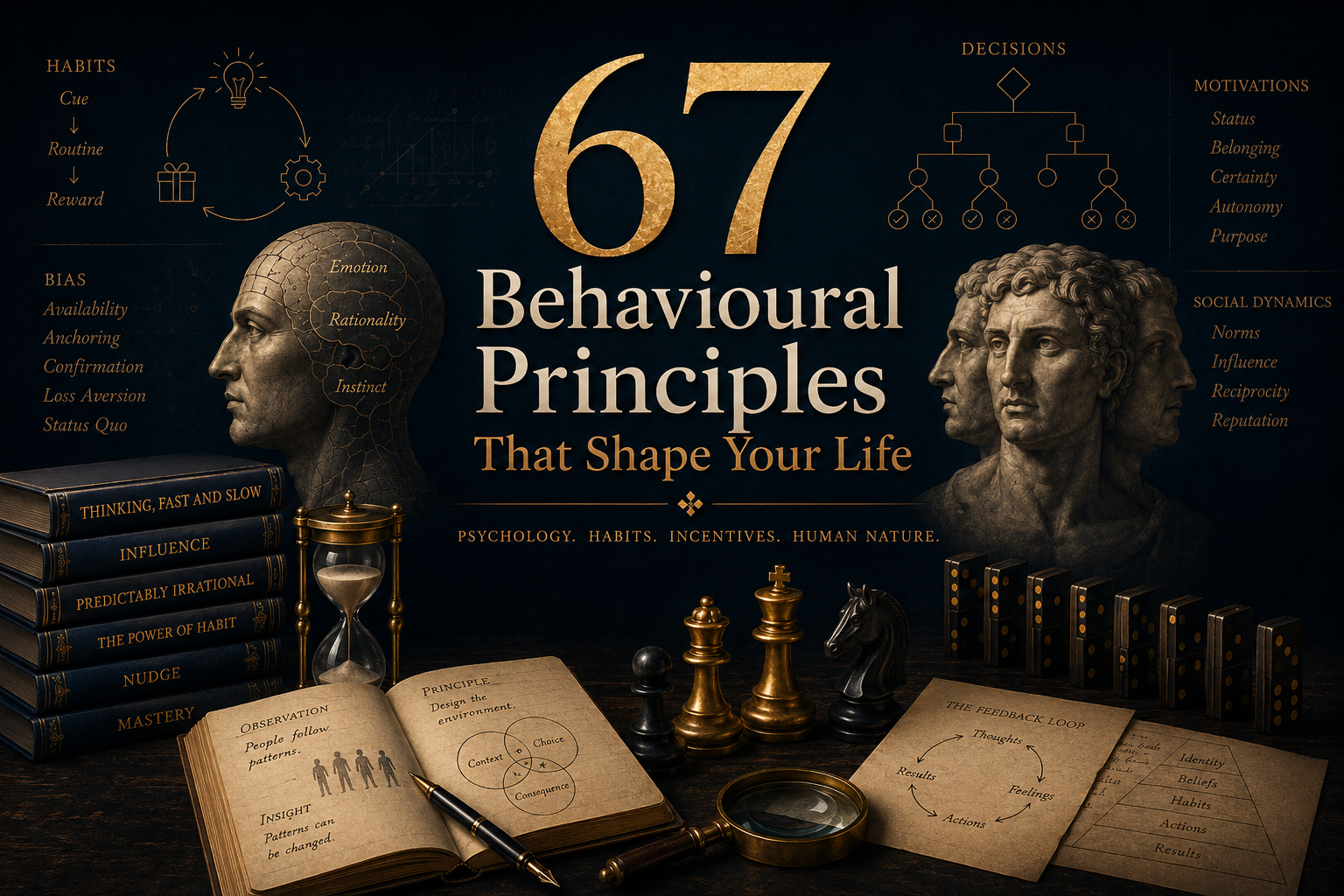
The Hidden Operating System Behind Human Behaviour
Most people believe they are consciously directing their lives.
In reality, much of human behaviour is automatic.
Our decisions are shaped by invisible psychological patterns we rarely notice: habits, cognitive biases, emotional conditioning, social influence, dopamine loops, environmental triggers, and unconscious identity patterns.
Modern life amplifies these forces.
Technology competes for attention. Social validation shapes self-worth. Constant stimulation rewires focus. Algorithms learn our behaviour faster than we understand it ourselves.
Yet the strange thing is this: many of these behavioural patterns are predictable.
The world’s greatest psychologists, behavioural scientists, neuroscientists, performance experts, and thinkers have spent decades uncovering the hidden mechanisms behind human action.
Why people procrastinate. Why habits form. Why attention collapses. Why discipline fades. Why emotions override logic. Why groups influence behaviour. Why some people repeatedly transform their lives while others remain trapped in the same cycles.
This series is an attempt to distil some of those ideas into practical principles for modern life.
Not motivational quotes.
Not recycled self-help clichés.
But deeper behavioural truths that quietly shape performance, relationships, discipline, confidence, focus, health, decision-making, leadership, and identity itself.
Because once you understand the mechanisms behind behaviour, you begin to see life differently.
You notice how environments shape action. You notice how attention changes emotion. You notice how habits become identity. You notice how repeated behaviours quietly become destiny.
The goal is not perfection.
The goal is awareness.
Because awareness creates choice. And choice changes lives.
Principle 1
The James Clear Principle That Quietly Changes Your Identity
“Every action you take is a vote for the type of person you wish to become.”
— James Clear
Most people think behaviour change starts with motivation.
It usually starts with identity.
This is one of the most important behavioural ideas James Clear popularised in Atomic Habits: human beings are constantly reinforcing self-image through repeated action.
Every behaviour quietly answers the question: what kind of person am I?
When someone repeatedly skips training, procrastinates, or avoids discomfort, they are not only creating outcomes. They are reinforcing identity.
Each workout reinforces “I am someone who trains”. Each difficult conversation reinforces “I am someone who confronts problems”. Each kept promise reinforces “I am someone who follows through”.
Most people attempt change backwards.
They focus only on outcomes: losing weight, making money, becoming productive, building confidence.
But behaviour that conflicts with identity rarely lasts.
The deeper shift happens when behaviour becomes evidence. Evidence creates belief. And belief eventually becomes identity.
Repeated behaviour does not just shape results. It quietly shapes the person performing it.
Principle 2
The Daniel Kahneman Bias That Explains Irrational Decisions
“Losses loom larger than gains.”
— Daniel Kahneman
Human beings are not rational creatures.
We are emotional creatures that rationalise afterwards.
Daniel Kahneman’s work in behavioural economics revealed one of the most powerful psychological distortions in human decision-making: loss aversion.
The pain of losing something psychologically feels stronger than the pleasure of gaining something equivalent.
This explains countless human behaviours.
Why people stay in bad jobs. Hold failing investments. Avoid difficult changes. Remain in unhealthy relationships. Fear embarrassment more than opportunity.
The brain interprets loss as threat. And humans are wired to avoid threat.
The problem is that modern life often requires short-term discomfort for long-term growth.
Starting a business risks failure. Changing careers risks uncertainty. Training hard risks discomfort. Speaking honestly risks rejection.
Yet avoiding these losses often creates larger long-term losses instead.
Human beings do not naturally choose what is best. They often choose what feels psychologically safest.
Principle 3
The Carl Jung Pattern That Quietly Controls Human Behaviour
“Until you make the unconscious conscious, it will direct your life and you will call it fate.”
— Carl Jung
Most people think they understand why they behave the way they do.
Usually, they only understand the surface.
Carl Jung believed that much of human behaviour is driven by unconscious patterns people fail to examine.
Emotional reactions. Repeated relationship dynamics. Self-sabotage. Avoidance. Fear. Resentment.
These patterns often operate automatically beneath conscious awareness.
The dangerous part is that unconscious behaviour feels personal and justified.
People rarely recognise they are repeating loops.
Instead, they blame circumstances, bad luck, other people, stress, or timing.
But behavioural patterns tend to repeat until they are consciously examined.
A person who never confronts insecurity may continually seek validation. A person who fears rejection may avoid opportunity. A person who suppresses emotion may become emotionally reactive without understanding why.
Many people are externally successful yet internally controlled by unconscious fears and patterns they have never explored.
Self-awareness is not simply philosophical. It is behavioural leverage.
Principle 4
The Andrew Huberman Insight About Dopamine Most People Miss
“Dopamine is about pursuit, not pleasure.”
— Andrew Huberman
Modern culture misunderstands dopamine.
Most people think dopamine is simply the chemical of happiness.
It is more accurately the chemical of pursuit.
Andrew Huberman has explained how dopamine drives motivation, anticipation, craving, and behavioural reinforcement.
This matters enormously in modern life because many technologies exploit the dopamine system directly.
Social media. Notifications. Short-form content. Online shopping. Constant novelty.
The brain becomes conditioned to expect continuous stimulation.
Over time, this changes behaviour.
People struggle to focus deeply, tolerate boredom, delay gratification, sustain long-term effort, and enjoy slower rewards.
The nervous system becomes trained for constant novelty.
This is one reason modern attention feels increasingly fragmented.
The problem is not simply distraction. It is dopamine dysregulation.
The things competing for your attention are often competing for your nervous system itself.
Principle 5
The Robert Cialdini Principle That Explains Why Humans Follow Crowds
“We view a behaviour as more correct in a given situation to the degree that we see others performing it.”
— Robert Cialdini
Human beings like to believe they think independently.
In reality, behaviour is deeply social.
Robert Cialdini’s work on persuasion revealed the enormous psychological power of social proof.
When humans feel uncertain, they instinctively look to others for behavioural guidance.
This affects nearly everything: trends, opinions, spending, politics, fitness, business, and online behaviour.
People often adopt behaviour not because it is correct, but because it appears socially validated.
The more uncertain the environment becomes, the stronger this effect grows.
This helps explain why crowds panic together, online outrage spreads rapidly, social media trends explode, group beliefs intensify, and bad ideas sometimes become normalised.
Humans are tribal creatures. Social agreement feels psychologically safe.
The danger is that crowds can amplify irrational behaviour just as easily as intelligent behaviour.
Many behaviours people consider personal choices are heavily shaped by invisible social influence.
Principle 6
The Jordan Peterson Idea About Responsibility Most People Avoid
“The purpose of life is finding the largest burden that you can bear and bearing it.”
— Jordan Peterson
Modern culture often treats responsibility as restriction.
Jordan Peterson argues the opposite.
Responsibility gives structure, meaning, and psychological stability.
Many people believe freedom comes from avoiding obligation.
Yet aimlessness often creates anxiety instead.
Without responsibility, discipline weakens, purpose fades, behaviour becomes reactive, and meaning deteriorates.
Humans appear to function best when moving toward something difficult and meaningful.
Responsibility creates direction. Direction organises behaviour.
This is why people frequently experience psychological improvement when they commit fully, take ownership, stop blaming circumstances, become useful to others, and pursue meaningful goals.
Avoidance may create temporary relief. But over time it often produces guilt, stagnation, resentment, and helplessness.
Peterson’s work resonates because it challenges one of the central illusions of modern life: that comfort automatically creates happiness.
Human beings often require meaningful struggle to feel psychologically alive.
Principle 7
The Tony Robbins Standard That Quietly Shapes Your Future
“The quality of your life is the quality of your standards.”
— Tony Robbins
Most people focus heavily on goals.
Tony Robbins argues that standards matter more.
Goals describe what you want.
Standards describe what you tolerate.
This distinction quietly shapes behaviour.
A person may want fitness, confidence, success, discipline, and strong relationships.
But if they tolerate excuses, inconsistency, low effort, poor environments, and destructive habits, their behaviour eventually aligns with those standards instead.
Human beings naturally adapt to what feels acceptable.
Over time, tolerated behaviour becomes normalised.
This applies everywhere: health, business, leadership, relationships, and self-respect.
People rarely rise far above the standards they repeatedly accept.
This is why behavioural change often requires more than information. It requires raising internal expectations.
Standards influence daily decisions long before outcomes appear.